
200-500 TPH Stone Crushing Plant Configuration Guide: Three Optimized Solutions
200-500 TPH Stone Crushing Plant Configurations: Complete Equipment Selection Guide
Project Overview: 200-500 TPH Aggregate Production Requirements
Standard Output Specifications
Three final product fractions:
0-5mm (manufactured sand)
5-20mm (construction aggregate)
20-40mm (road base material)
Feed material size: ≤600mm
Target capacity: 200-500 TPH (adjustable based on material hardness)
Configuration 1
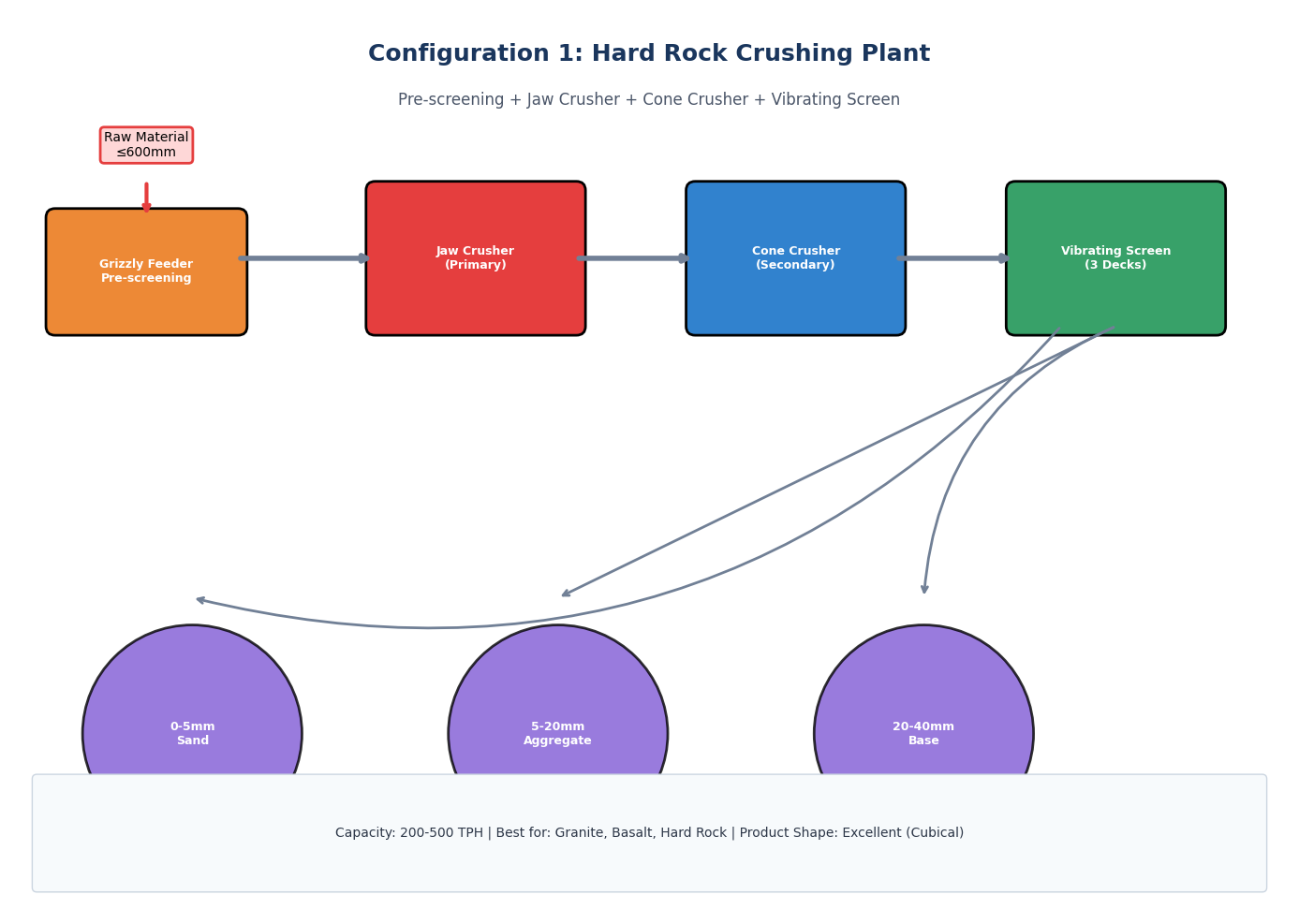
Pre-screening + Vibrating Feeder + Jaw Crusher + Cone Crusher + Vibrating Screen
Equipment Configuration Details
| Stage | Equipment Model | Function | Technical Parameters |
|---|---|---|---|
| Pre-screening | Grizzly Feeder / Scalping Screen | Remove fines <50mm, reduce crusher load | Capacity: 250-600 TPH, Screen opening: 50mm |
| Primary Crushing | PE Series Jaw Crusher | Coarse crushing of hard rock | Feed opening: 600×900mm, Power: 75-110kW |
| Secondary Crushing | Cone Crusher (Spring or Hydraulic) | Medium-fine crushing, cubical shape | Crushing cavity: Medium/Short head, Power: 160-250kW |
| Screening | 3YK Series Vibrating Screen | Three-fraction classification | Screen layers: 3, Screen area: 15-20㎡ |
Application Scenarios
This hard rock crushing configuration is specifically designed for:
Granite quarries with high silica content
Basalt mining operations requiring excellent particle shape
River pebble processing for high-grade concrete aggregate
Technical Advantages
1. Superior Wear Resistance
The jaw crusher + cone crusher combination handles abrasive materials with manganese steel wear parts lasting 400-600 hours in granite applications, compared to 80-120 hours for impact-type crushers.
2. Optimal Particle Shape
Cone crushers produce cubical aggregates with flakiness index <10%, meeting strict concrete and asphalt specifications for infrastructure projects.
3. Pre-screening Efficiency
Removing 15-25% of fines before primary crushing reduces jaw crusher wear by 30% and increases overall plant capacity by 20%.
Investment & Operating Costs
Initial investment: $450,000–$680,000 (complete stationary plant)
Power consumption: 0.9–1.1 kWh/ton
Wear parts cost: $0.8–$1.2 per ton (hard rock)
Configuration 2
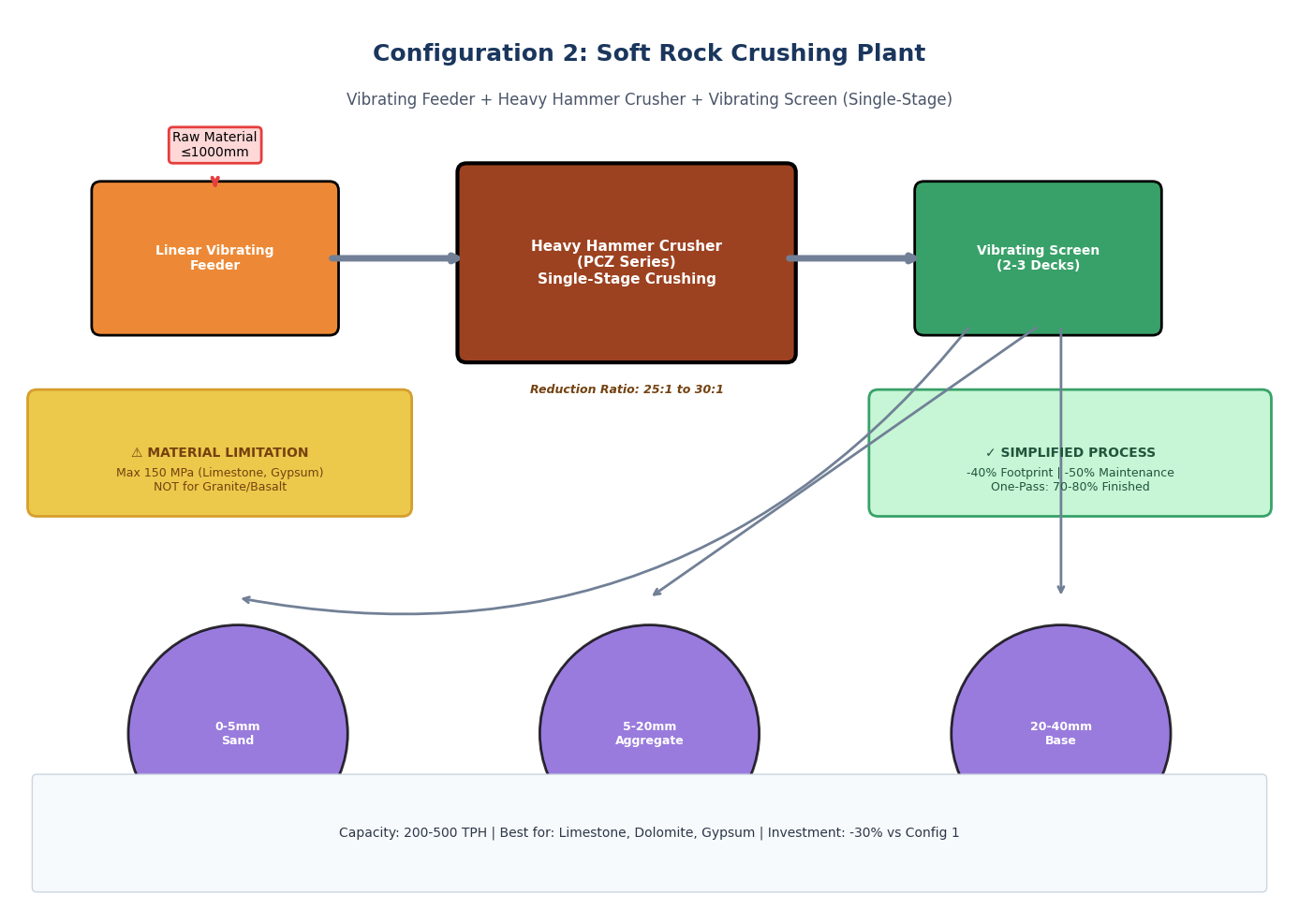
Vibrating Feeder + Heavy Hammer Crusher + Vibrating Screen
Equipment Configuration Details
| Stage | Equipment Model | Function | Technical Parameters |
|---|---|---|---|
| Feeding | ZSW Linear Vibrating Feeder | Uniform feeding, pre-screening | Capacity: 300-600 TPH, Vibration frequency: 850-900 r/min |
| Primary/Secondary | Heavy Hammer Crusher (PCZ Series) | One-stage crushing, high reduction ratio | Rotor diameter: 1600-2000mm, Power: 250-400kW |
| Screening | Circular Vibrating Screen | Three-product classification | Screen layers: 2-3, Capacity: 200-500 TPH |
Application Scenarios
This single-stage crushing solution excels in:
Limestone quarries with compressive strength <150 MPa
Gypsum mining operations
Dolomite processing for cement plants
Shale and soft rock applications
Technical Advantages
1. Simplified Process Flow
Eliminating secondary crushing reduces equipment footprint by 40% and maintenance points by 50%. The heavy hammer crusher achieves maximum feeding size 1000mm with discharge size <25mm in one stage.
2. Cost Efficiency
Lower initial investment (30-40% less than jaw+cone configuration) and reduced conveyor requirements make this ideal for budget-conscious operations.
3. High Reduction Ratio
Heavy hammer crushers achieve 25:1 to 30:1 reduction ratios, producing 70-80% finished products in one pass.
Critical Considerations
⚠️ Material Hardness Limitation:
This configuration is NOT recommended for granite, quartzite, or basalt. Hammer wear rates increase exponentially above 150 MPa compressive strength, potentially reaching $3-5 per ton operating cost versus $0.5-0.8 for soft limestone.
Investment & Operating Costs
Initial investment: $280,000–$420,000
Power consumption: 0.7–0.9 kWh/ton (soft rock)
Wear parts cost:
$0.3–$0.6 per ton (limestone)
$2.5–$4.0 per ton (hard rock)
Configuration 3
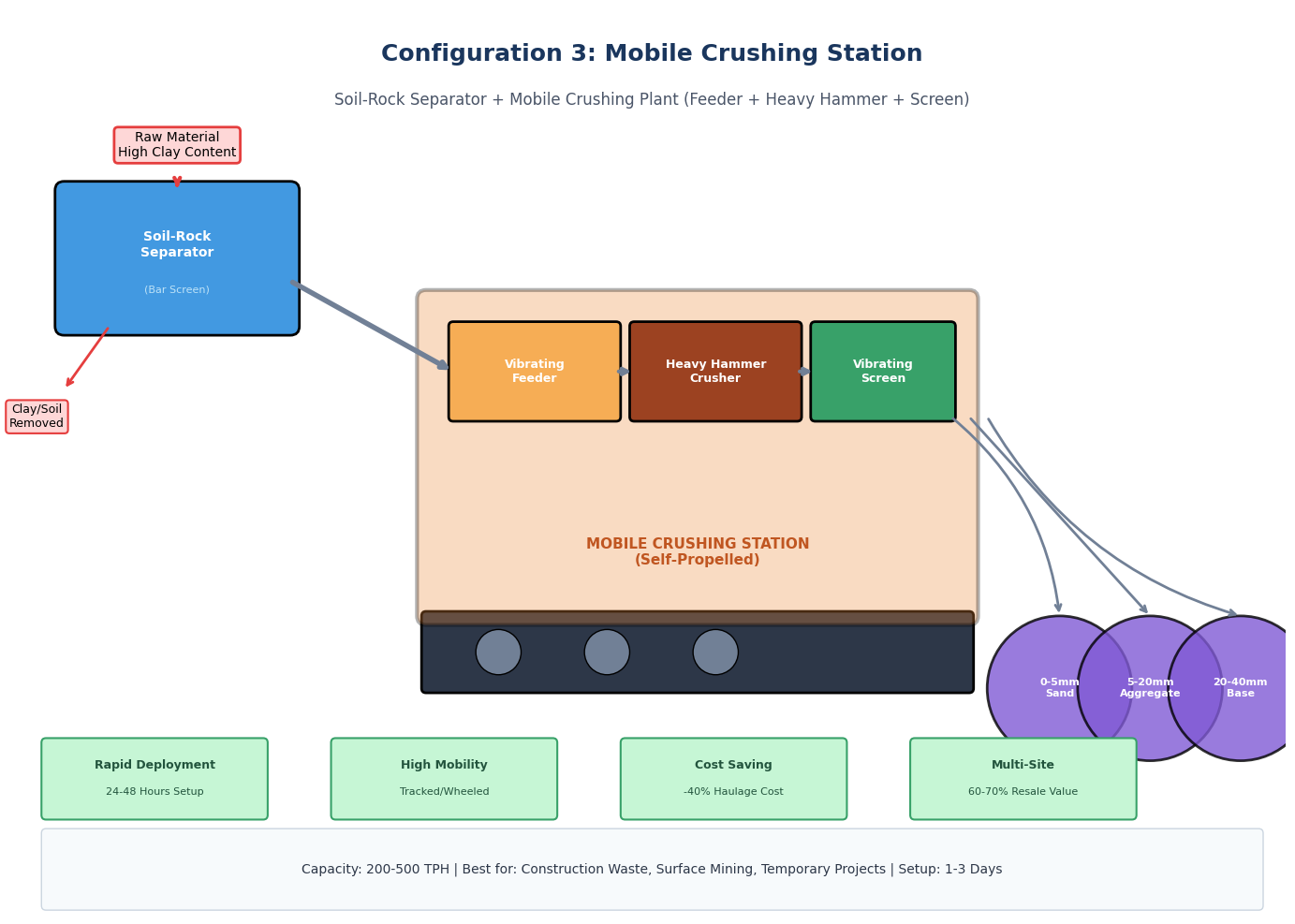
Soil-Rock Separator + Mobile Crushing Station (Feeder + Heavy Hammer Crusher + Screen)
Equipment Configuration Details
| Module | Equipment Component | Function | Mobility Features |
|---|---|---|---|
| Pre-treatment | Soil-Rock Separator (Bar Screen Type) | Remove clay, soil, and fines <30mm | Fixed or semi-mobile installation |
| Crushing Module | Mobile Impact/Hammer Crushing Station | Primary crushing with integrated screening | Tracked or wheeled chassis, self-propelled |
| Screening Module | Mobile Triple-Deck Screen | Three-fraction final screening | Hydraulic folding conveyors, rapid setup |
Application Scenarios
This flexible crushing solution is optimal for:
Construction waste recycling with high clay content
Surface mining operations requiring frequent relocation
Temporary quarry projects (1-3 years duration)
Urban demolition sites with space constraints
Road construction projects moving with job progress
Technical Advantages
1. Clay Management
The soil-rock separator removes sticky fines before crushing, preventing crusher chamber clogging and reducing wear by 40% in high-moisture conditions.
2. Rapid Deployment
Mobile stations achieve operational status within 24-48 hours of site arrival, compared to 4-8 weeks for fixed installations.
3. Transportation Cost Reduction
Processing materials at the extraction face eliminates haulage costs, which can represent 40-50% of total operating expenses in fixed plant configurations.
4. Multi-Site Utilization
After project completion, mobile equipment retains 60-70% resale value and can be redeployed to new locations, unlike fixed installations with sunk civil engineering costs.
Capacity Considerations
While mobile configurations offer unmatched flexibility, 200-500 TPH capacity requires validation:
Tracked jaw crushers: Typically 100-400 TPH
Wheeled impact crushers: Up to 500 TPH achievable with large rotor designs
For sustained 400-500 TPH operation in hard rock, dual mobile trains (primary + secondary) may be necessary.
Investment & Operating Costs
Initial investment: $350,000–$650,000 (depending on mobility type)
Setup time: 1-3 days vs. 4-8 weeks for fixed plants
Operating cost: 15-25% lower than fixed plants when haulage distances exceed 3km
Configuration Comparison Matrix
| Parameter | Config 1: Jaw+Cone | Config 2: Heavy Hammer | Config 3: Mobile Station |
|---|---|---|---|
| Best Material | Granite, Basalt, Hard Rock | Limestone, Soft Rock | Variable/Mixed with clay |
| Initial Investment | High ($450k–$680k) | Low ($280k–$420k) | Medium ($350k–$650k) |
| Operating Cost/Ton | Low ($0.8–$1.2) | Very Low ($0.3–$0.6)* | Medium ($0.9–$1.4) |
| Product Shape | Excellent (cubical) | Good | Good |
| Mobility | None | None | High (tracked/wheeled) |
| Setup Time | 6-8 weeks | 4-6 weeks | 1-3 days |
| Capacity Range | 200-800 TPH | 150-600 TPH | 100-500 TPH |
| Wear Parts Life | Long (400-600 hrs) | Short (100-200 hrs)** | Medium (200-400 hrs) |
* For soft rock only. Hard rock increases costs 3-4x.
** Hammer crushers in soft rock applications.
Selection Decision Framework
Choose Configuration 1 (Jaw+Cone) When:
Raw material hardness > 200 MPa (granite, basalt, gabbro)
Long-term operation (>5 years) at single location
Strict aggregate shape requirements for concrete/asphalt
High daily production consistency required
Choose Configuration 2 (Heavy Hammer) When:
Material is limestone, dolomite, or gypsum (<150 MPa)
Budget constraints prioritize low initial investment
Single-stage simplicity reduces maintenance complexity
Site has limited space for multi-stage layout
Choose Configuration 3 (Mobile) When:
Project duration is 1-3 years or extraction face moves frequently
Raw material contains >15% clay or soil requiring pre-separation
Haulage distance from face to plant exceeds 3 kilometers
Rapid startup is critical (emergency replacement, temporary contracts)
Environmental permits favor reduced dust and noise mobility
Technical Implementation Notes
Power Requirements
200 TPH plant: 350-450 kW total installed power
500 TPH plant: 800-1000 kW total installed power
Power density rule:
1.0-1.2 kW per TPH for hard rock
0.8-1.0 kW for soft rock
Environmental Compliance
Dust suppression: Dry fog systems at transfer points (70-80% reduction)
Noise control: Enclosed crusher housings for urban mobile applications
Water consumption: 0.3-0.5 m³/ton for washing (if required)
Maintenance Planning
Fixed plants: Schedule liner changes every 250-400 hours for hard rock
Mobile plants: Daily undercarriage inspection, hydraulic system checks every 50 hours
Spare parts inventory: Maintain 3-4 months critical spares for remote operations