
China Environmental Regulations 2026: Complete Green Transformation Guide for Aggregate and Sand Industry
China Environmental Regulations 2026: Complete Green Transformation Guide for Aggregate and Sand Industry
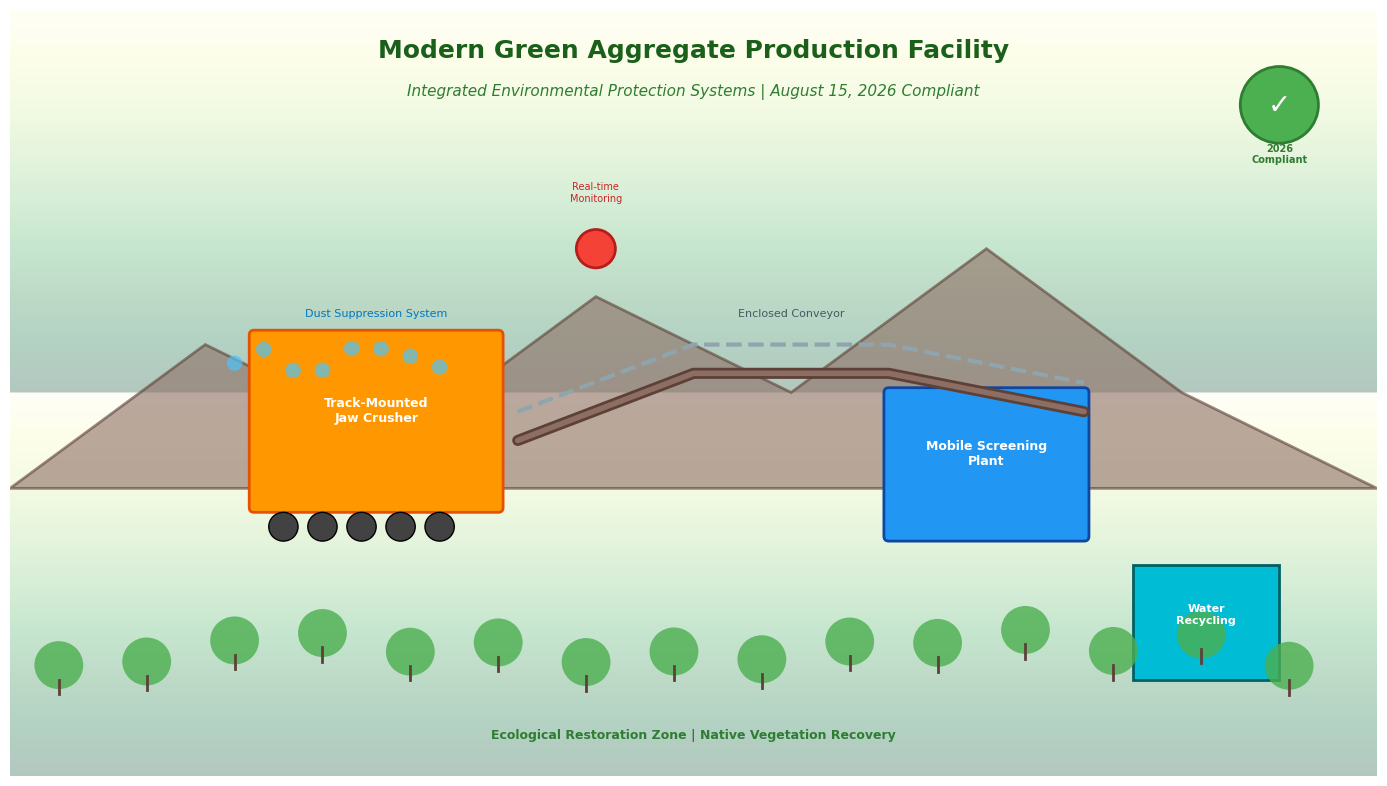
Table of Contents
Policy Overview: August 15, 2026 Implementation
Green Low-Carbon Development: Core Industry Direction
Full-Cycle Compliance: Enhanced Operational Standards
Ecological Restoration: Mandatory Land Rehabilitation
Legal Liability Framework: Industry Restructuring
Strategic Opportunities for Equipment Suppliers
Global Market Context: Compliance as Competitive Advantage
Action Plan for Aggregate Producers
Policy Overview: August 15, 2026 Implementation {#overview}
On March 12, 2026, comprehensive environmental regulations were formally adopted, with full implementation scheduled for August 15, 2026 (National Ecology Day). This landmark policy framework establishes clear pathways for sustainable development across China's aggregate production, quarry operations, and construction materials sectors.
The new regulations consolidate existing environmental statutes into a unified framework comprising 5 sections and 1,242 articles. For aggregate producers, sand and gravel operators, and construction material suppliers, this creates both compliance obligations and competitive positioning opportunities in the evolving global marketplace.
Key Implementation Timeline
March 12, 2026: Formal adoption and publication
August 15, 2026: Full regulatory effect
Immediate Impact: Replacement of previous environmental protection frameworks
Related Reading: Mobile Crushing Plant Selection Guide: Environmental Performance Comparison
Green Low-Carbon Development: Core Industry Direction {#green-development}
The 2026 regulations establish green low-carbon development as a dedicated regulatory pillar, requiring aggregate producers to implement comprehensive carbon management strategies. This aligns with global market trends where the mobile crushing and screening equipment market is projected to reach USD 8.5 billion by 2035, growing at a CAGR of 4.8%.
Critical Requirements for Aggregate Operations
| Compliance Area | Specific Requirements | Implementation Timeline |
|---|---|---|
| Carbon Management | Greenhouse gas emission monitoring and reduction across all operations | Immediate upon effectiveness |
| Energy Efficiency | Phase-out of high-consumption equipment; adoption of intelligent, low-energy crushing technologies | 12-24 month transition period |
| Quality Standards | Shift from volume-based to quality-focused production models | Ongoing compliance required |
Market Opportunity
The global sand and gravel market faces increasing regulatory challenges worldwide, with environmental compliance becoming a key competitive differentiator. Chinese aggregate equipment manufacturers achieving green certification gain preferential access to international infrastructure projects.
Available Financial Incentives
Government subsidies for environmental infrastructure upgrades
Tax incentives for certified green mining operations
Preferential financing for sustainable equipment procurement
Industry Insight
The Asia-Pacific region dominates the mobile crushers and screeners market with 30.9% revenue share in 2024, driven by infrastructure investment in China, India, and Southeast Asia.
Full-Cycle Compliance: Enhanced Operational Standards
The 2026 regulations mandate comprehensive environmental standards across the entire aggregate production value chain—from extraction through processing to transportation.
Quarry Extraction Phase Requirements
Dust Suppression Systems: Mandatory installation of airborne particle control systems meeting PM2.5 and PM10 standards
Water and Soil Conservation: Strict adherence to watershed protection and soil stabilization protocols
Ecological Protection Zones: Prohibition of extraction activities in sensitive ecological areas, nature reserves, and protected watersheds
Spatial Planning Compliance: All quarry development must align with territorial spatial planning and ecological control requirements
Aggregate Processing Phase Standards
Pollution Control Infrastructure: Required installation of dust collection systems and wastewater treatment facilities
Solid Waste Management: Regulated handling of tailings, waste rock, and construction debris
Clean Production Technology: Mandatory adoption of low-emission processing equipment; prohibition of outdated high-pollution technologies
Transportation and Logistics Compliance
Enclosed Transport Systems: Mandatory use of covered conveyors, sealed transport vehicles, and dust-proof loading facilities
Noise Mitigation: Compliance with strict decibel limits for crushing and screening operations
Route Optimization: Minimization of transport distances through residential and sensitive areas
Product Spotlight: Track-Mounted Mobile Jaw Crusher with Integrated Dust Suppression
Enhanced Permit Management and Monitoring
The regulations strengthen emission permit management for aggregate operations:
✓ Mandatory Permitting: All quarry operations must obtain environmental permits before commencing production
✓ Transparency Requirements: Major operators must publicly disclose pollutant emissions and carbon footprint data
✓ Continuous Monitoring: Installation of real-time environmental monitoring systems
✓ Data Integrity: Legal accountability for accuracy and completeness of environmental reporting
Enforcement Mechanisms
Permit revocation for non-compliant operations
Administrative penalties and fines
Legal liability for responsible personnel
Criminal prosecution for severe violations including data falsification
Compliance Tip: Early investment in integrated monitoring systems reduces long-term operational risks and positions operators for premium project contracts.
Ecological Restoration: Mandatory Land Rehabilitation {#restoration}
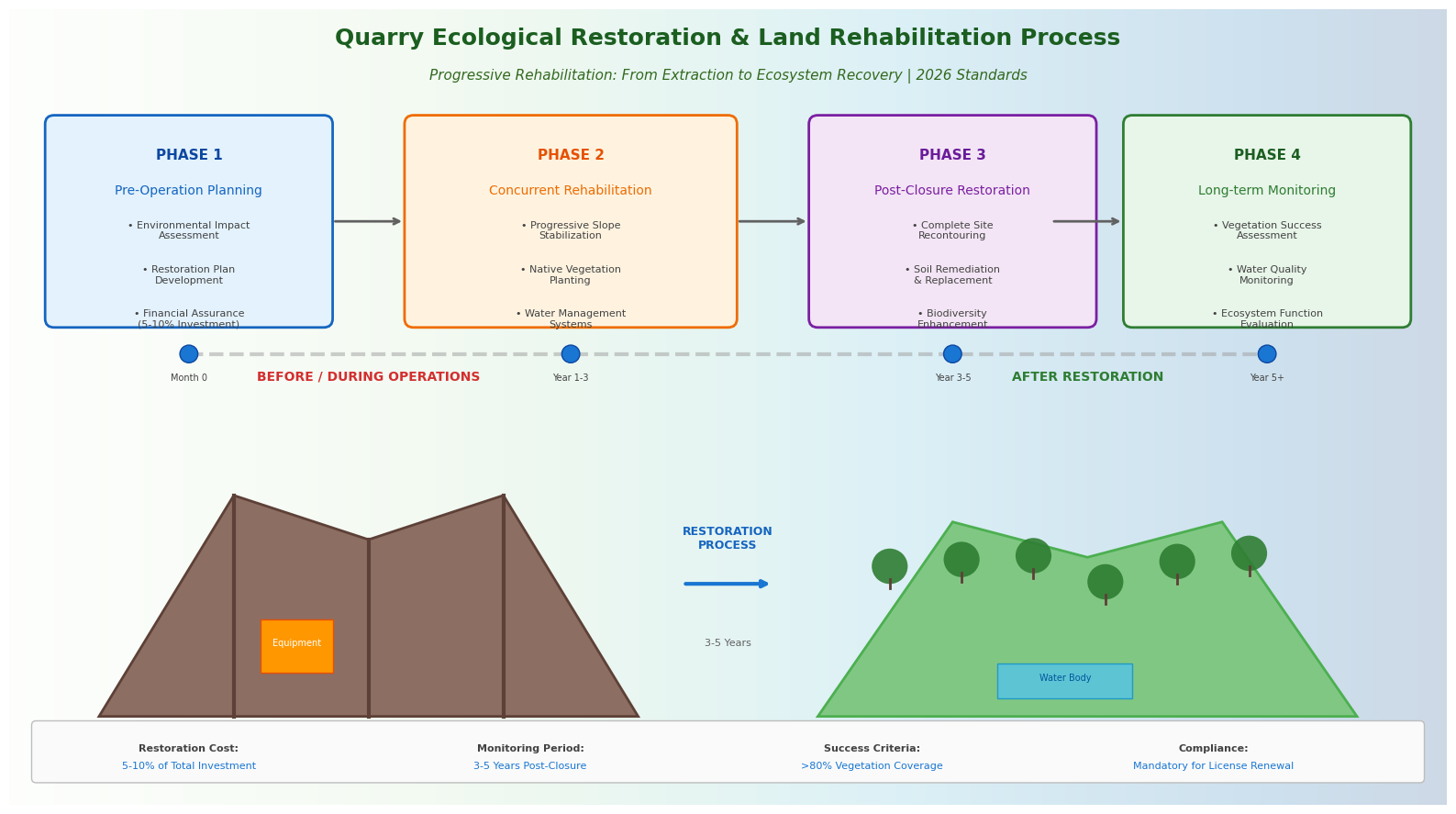
The 2026 regulations mandate integrated ecological restoration following holistic ecosystem management principles. For aggregate quarry operations, this creates binding rehabilitation obligations.
Four-Pillar Restoration Framework
1. Pre-Operation Planning
Comprehensive ecological restoration plans required before extraction commencement
Third-party environmental impact assessments
Community stakeholder consultation documentation
2. Financial Assurance
Full provisioning of restoration funds through escrow accounts or performance bonds
Typically 5-10% of total project investment
Regular audit and verification requirements
3. Progressive Rehabilitation
Concurrent restoration during active operations
Vegetation recovery and soil stabilization protocols
Biodiversity monitoring and enhancement programs
4. Completion Standards
Independent verification of restoration quality
Mining license renewal contingent upon satisfactory rehabilitation
Long-term monitoring periods (typically 3-5 years post-closure)
Geographic Restrictions
Enhanced protections for Yangtze River and Yellow River basins
Strict limitations on extraction in priority ecological regions
Mining rights allocation prioritizing ecological conservation needs
Case Study: Successful Quarry Rehabilitation Project: From Extraction Site to Community Park
Legal Liability Framework: Industry Restructuring {#liability}
The 2026 regulations establish a three-tier liability system (administrative, civil, and criminal) for environmental violations, substantially increasing non-compliance costs.
Priority Enforcement Areas
| Violation Type | Administrative Penalty | Criminal Liability |
|---|---|---|
| Exceeding emission standards | Fines up to USD 150,000; production suspension | Possible for repeated violations |
| Operating without permits | Business closure; asset seizure | Yes, for significant environmental damage |
| Incomplete restoration | Permit denial; restoration cost recovery | Yes, for fraudulent reporting |
| Data falsification | License revocation; industry blacklisting | Yes, mandatory prosecution |
Dual Liability Structure
Both corporate entities and individual responsible persons face legal consequences, creating strong accountability throughout organizational hierarchies.
Market Transformation Impact
Accelerated consolidation as smaller operators exit due to compliance costs
Market share concentration among large-scale compliant enterprises
Premium pricing power for certified green aggregate products
Enhanced barriers to entry for new market participants
Strategic Opportunities for Equipment Suppliers {#opportunities}
For international aggregate equipment manufacturers and mobile crushing plant suppliers, China's regulatory evolution creates significant market opportunities.
Compliance-First Equipment Solutions
Featured Product Categories:
Dust-Controlled Crushing Plants: Mobile jaw crushers and impact crushers with integrated dust suppression systems
Low-Noise Operations: Electric and hybrid power systems reducing noise emissions by 40-60%
Water Recycling Systems: Closed-loop water management for washing and processing operations
Enclosed Screening Solutions: Dust-tight screening plants with negative pressure systems
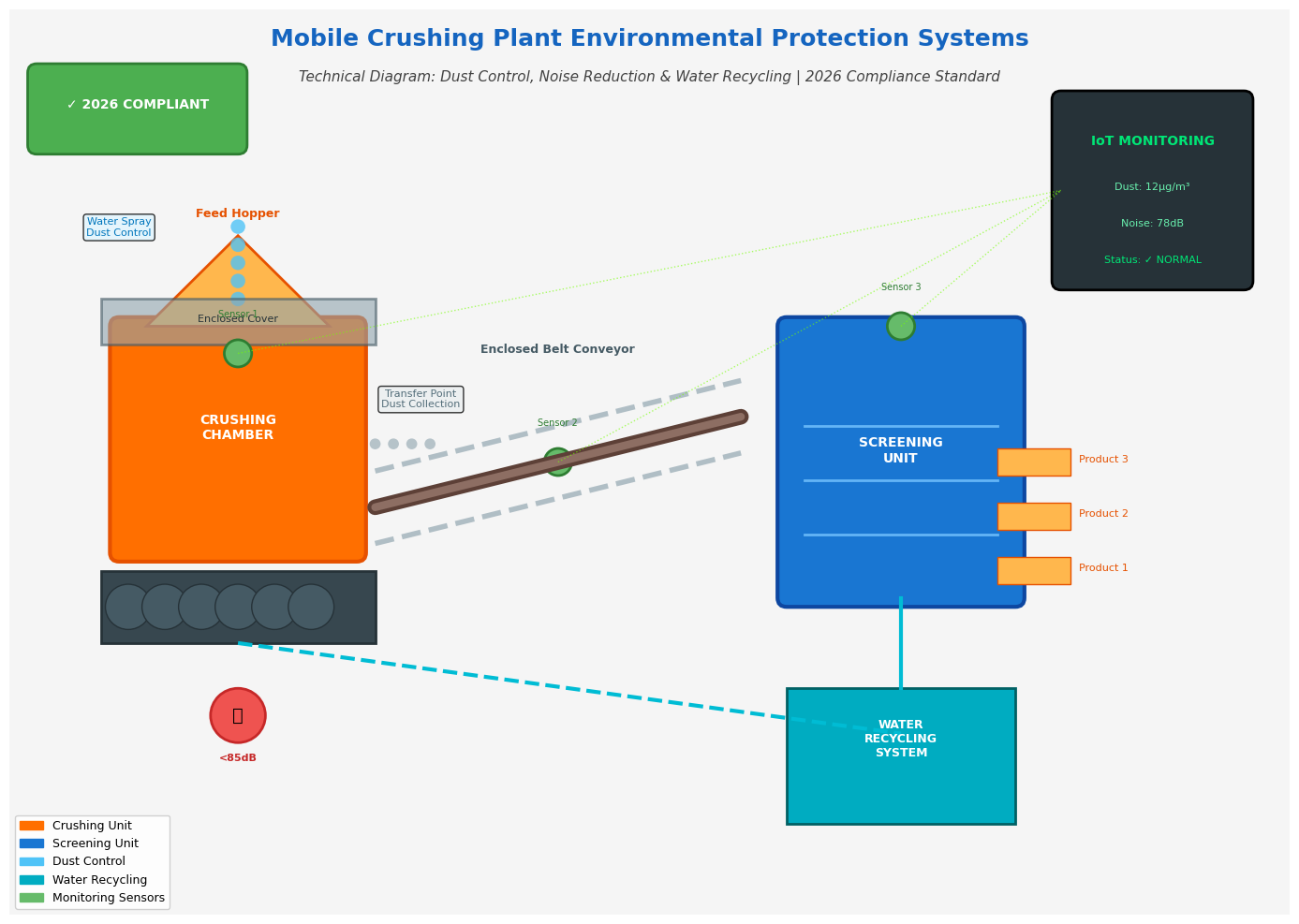
Technical Specifications: Download Mobile Crushing Plant Environmental Compliance Checklist
Green Quarry Development Services
Turnkey Solutions: Comprehensive green quarry design, equipment supply, and commissioning
Environmental Monitoring: IoT-based real-time compliance monitoring systems
Restoration Planning: Technical support for ecological rehabilitation and land reclamation
Training Programs: Operator certification for environmental compliance management
Technology Innovation Priorities
Tracked Mobile Crushers: Superior mobility for challenging terrain (fastest-growing segment at 6.2% CAGR)
Hybrid Power Systems: Diesel-electric and full-electric configurations reducing carbon footprint by 30-50%
Smart Automation: AI-driven process optimization reducing energy consumption by 15-25%
Modular Designs: Flexible, scalable plant configurations for diverse project requirements
Product Highlight: Hengtai HT-300T Tracked Mobile Crushing Station with Tier 4 Final Engine and Smart Dust Control
Global Market Context: Compliance as Competitive Advantage {#global-context}
The global aggregates industry faces intensifying environmental scrutiny across all major markets. Regulatory compliance has evolved from cost center to competitive differentiator.
Regional Market Dynamics (2026-2035)
| Region | Market Share | Growth Driver | Compliance Trend |
|---|---|---|---|
| Asia-Pacific | 30.9% | Infrastructure investment (China, India, SE Asia) | Rapid standardization |
| North America | 24.5% | Sustainable quarry technology adoption | Mature enforcement |
| Europe | 22.1% | Circular economy regulations | Leading recycling integration |
| Middle East & Africa | 14.8% | Mega-project development | Emerging frameworks |
| Latin America | 7.7% | Urbanization and construction | Catching up phase |
Competitive Positioning Strategy
Equipment suppliers demonstrating proven environmental compliance capabilities gain preferential positioning for:
Government infrastructure projects requiring sustainable sourcing
International financing requiring environmental due diligence
Corporate clients with ESG (Environmental, Social, Governance) commitments
Premium market segments paying compliance premiums of 10-15%
Market Intelligence: Download 2026 Global Aggregate Equipment Market Report
Action Plan for Aggregate Producers {#action-plan}
Phase 1: Immediate Actions (March–August 2026)
Conduct comprehensive environmental compliance audit
Review and update environmental permits and licenses
Install real-time monitoring systems for dust, noise, and emissions
Establish relationships with certified environmental consultants
Phase 2: Equipment Upgrades (August 2026 – August 2027)
Replace high-emission processing equipment with compliant alternatives
Implement dust suppression systems at all material handling points
Install wastewater treatment and recycling facilities
Transition to enclosed transport systems
Phase 3: Operational Excellence (Ongoing)
Achieve green mining certification
Implement ISO 14001 environmental management systems
Establish progressive rehabilitation programs
Develop carbon footprint reduction targets and reporting
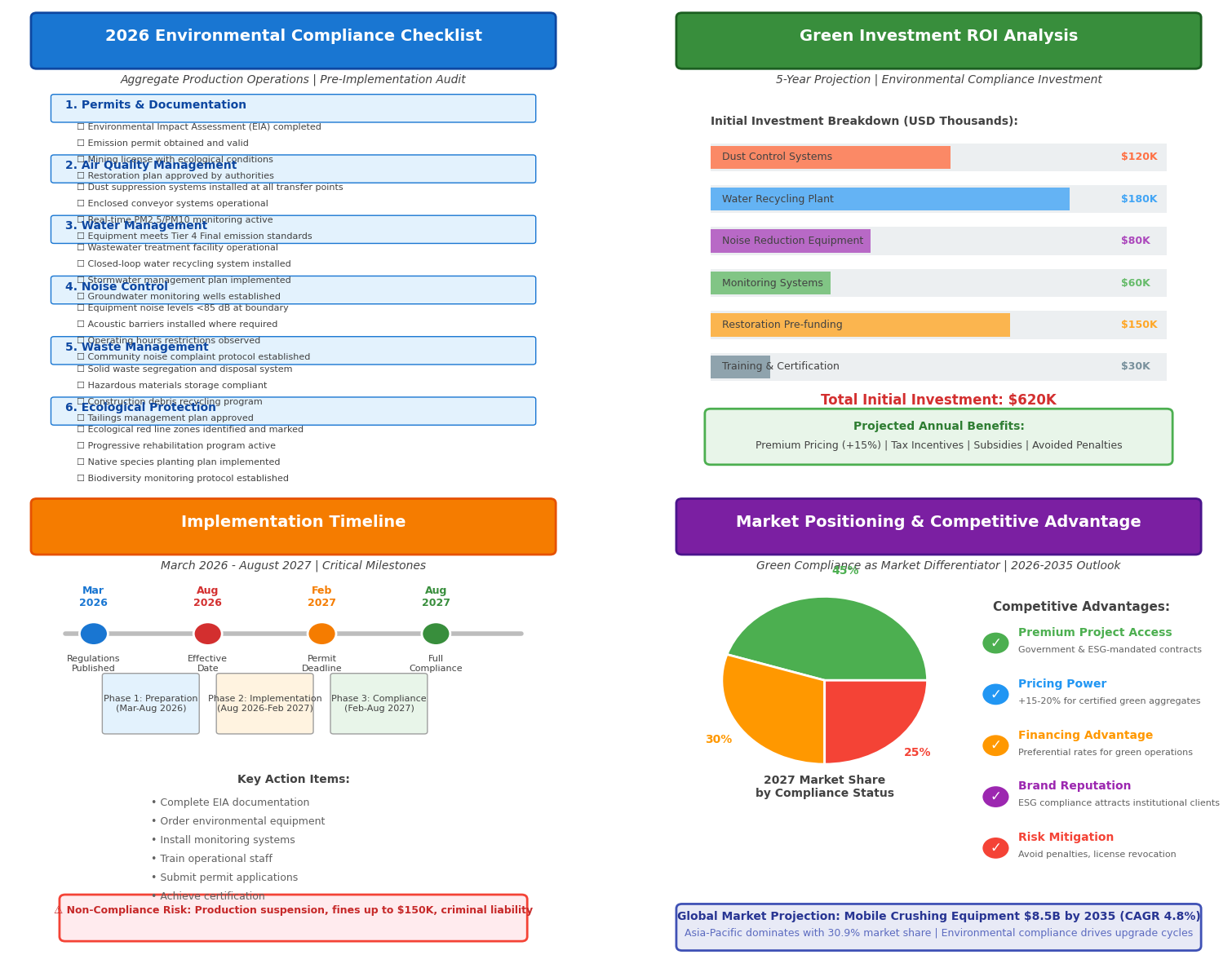
ROI Projection
Frequently Asked Questions (FAQ Schema)
Q: What is the effective date of the new environmental regulations?
A: The regulations take effect on August 15, 2026, following formal adoption on March 12, 2026.
Q: Do the regulations apply to existing quarry operations or only new projects?
A: The regulations apply to all operations, with existing facilities granted transition periods of 12-24 months for equipment upgrades and permit modifications.
Q: What are the penalties for non-compliance?
A: Penalties range from administrative fines and production suspension to permit revocation and criminal prosecution for severe violations. The dual liability system holds both enterprises and individual managers accountable.
Q: How can aggregate producers access financial incentives for green upgrades?
A: Government subsidies, tax incentives, and preferential financing are available through local environmental protection bureaus and state-owned banks. Certification as a "Green Mine" unlocks additional benefits.
Q: What mobile crushing equipment features are required for compliance?
A: Key features include integrated dust suppression systems, noise reduction technology (typically <85 dB), energy-efficient power systems, and enclosed material transport. Hybrid and electric configurations offer additional compliance advantages.