Hard Rock vs Soft Rock
Basic Rock Classification for Aggregate Crushing Plants
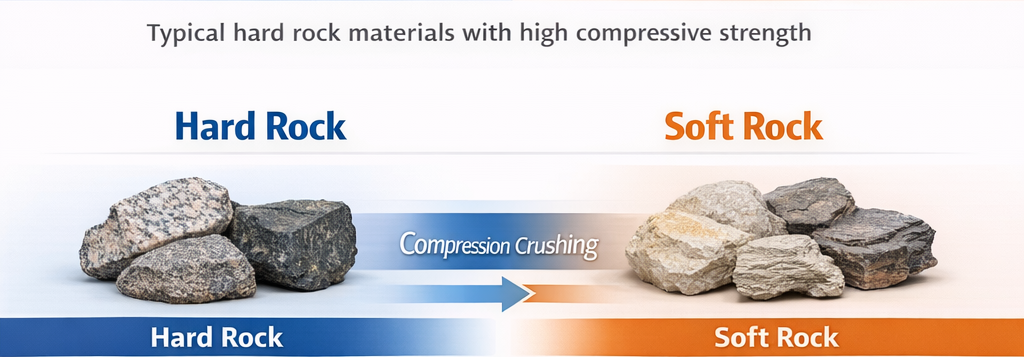
In aggregate and sand production, whether the rock is hard or soft plays a critical role in crusher selection, production line design, equipment wear, and long-term operating costs.
However, in many quarry and aggregate projects, plant owners are not fully aware of the actual rock properties of their materials and rely entirely on design engineers or equipment suppliers.
While this may simplify decision-making, it can also lead to hidden risks such as:
Overdesigned equipment and higher initial investment
Mismatch between rock type and crusher, causing excessive wear
Higher energy consumption and unstable output
Limited flexibility for future production adjustments
Understanding the basic difference between hard rock and soft rock is therefore essential for a reliable and cost-effective crushing plant.
1. How Is Rock Hardness Classified?
Rock hardness is not judged subjectively. In engineering practice, it is determined by several physical and mechanical properties, including:
Compressive strength
Rock density and structure
Drillability and blastability
Abrasion resistance
Among these factors, compressive strength (MPa) is the most widely used parameter in the crushing and screening industry.
2. What Is Hard Rock?
2.1 Definition of Hard Rock
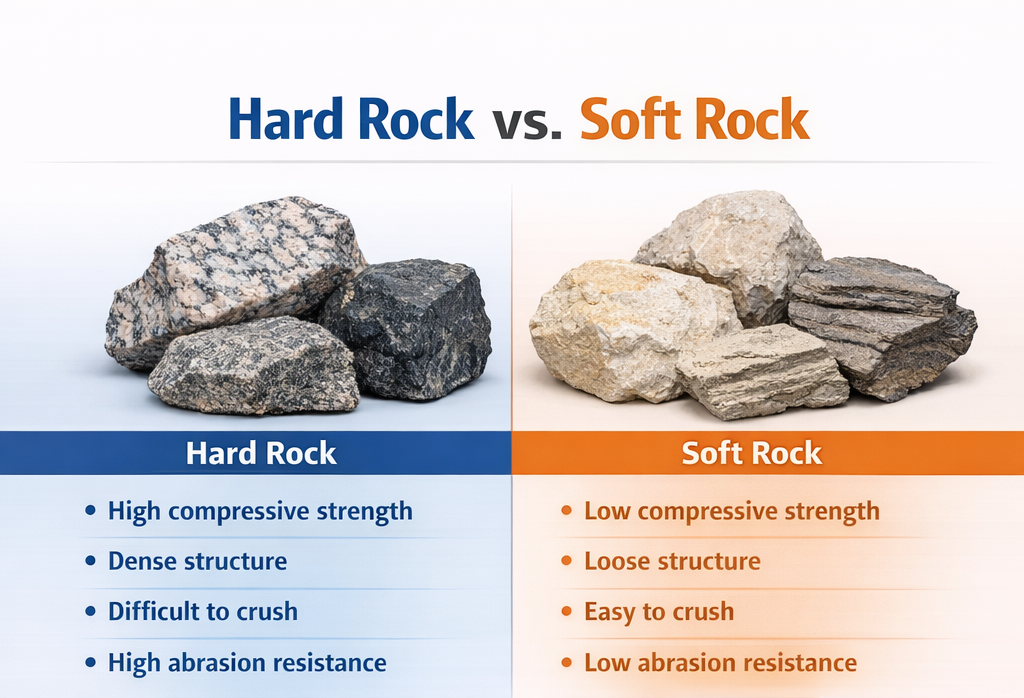
Hard rock refers to rocks with high compressive strength (generally ≥100 MPa), dense structure, and strong integrity.
These rocks are difficult to crush and typically cause higher wear on crushing equipment.
2.2 Common Types of Hard Rock
Hard rock mainly includes:
Igneous rocks
Granite
Basalt
Diabase
Metamorphic rocks
Quartzite
Gneiss
Some high-strength sedimentary rocks
Siliceous cemented rock
Iron or calcium cemented clastic rock
2.3 Typical Compressive Strength of Hard Rock
| Rock Type | Compressive Strength (MPa) |
|---|---|
| Granite | 150–300 |
| Basalt | 200–350 |
| Diabase | 200–300 |
| Quartzite | 300–400 |
| Gneiss | 100–250 |
Engineering characteristics:
Hard rock offers excellent durability and high-quality aggregates, but requires robust and wear-resistant crushing equipment.
3. What Is Soft Rock?
3.1 Definition of Soft Rock
Soft rock refers to rocks with low compressive strength (generally <60 MPa), loose structure, and easy breakability.
These materials are easier to crush and cause less wear on equipment.
3.2 Common Types of Soft Rock
Limestone
Sandstone (highly dependent on cementation)
Shale
Mudstone
3.3 Typical Compressive Strength of Soft Rock
| Rock Type | Compressive Strength (MPa) |
|---|---|
| Limestone | 30–150 (mostly <100) |
| Sandstone | 20–150 (depends on cementation) |
| Shale | 5–50 |
Important note:
Some limestones and sandstones with strong cementation may behave like medium-hard rock and should not be treated as typical soft rock without testing.
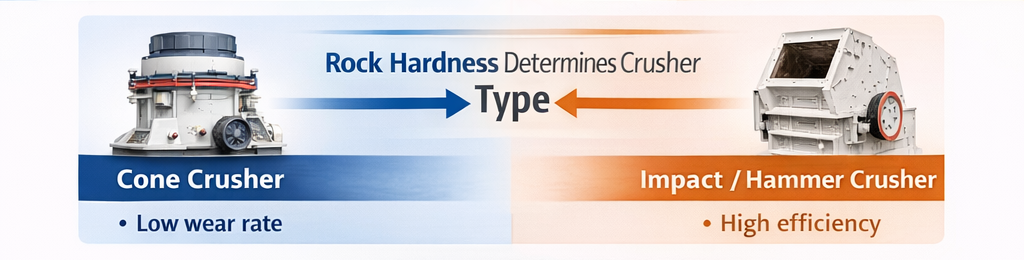
4.Impact of Rock Hardness on Crusher Selection
The difference between hard rock and soft rock mainly affects the secondary and tertiary crushing stages.
4.1 Crusher Selection for Hard Rock
Hard rock crushing requires equipment that minimizes impact wear.
Therefore, compression-type crushers are commonly used:
Cone Crusher
Suitable for granite, basalt, diabase, and other hard rocks
Stable operation and lower wear rate
Ideal for long-term secondary and tertiary crushing
4.2 Crusher Selection for Soft Rock
Soft rock is better processed using impact crushing to achieve higher efficiency and better particle shape:
Impact Crusher
Hammer Crusher
These crushers have simpler structures and lower investment costs, making them suitable for limestone and other low-strength materials.
5. Why Understanding Rock Properties Matters in Plant Design
Rock properties are fundamental parameters in aggregate production line design.
Lack of accurate understanding may result in:
Excessive equipment configuration
Higher power consumption
Unexpected wear of spare parts
Increased maintenance and retrofit costs
Having basic knowledge of rock classification allows plant owners to better evaluate design proposals and equipment selection, improving overall project economics.
6. Conclusion
Accurate rock identification and testing at the early stage of a project are essential for achieving stable production and cost-effective operation.