
ZW Feeder Installation Pitfalls: Field Commissioning Best Practices
ZW Feeder Installation Pitfalls: Field Commissioning Best Practices
Meta Description:
Practical experience for ZW feeder installation and commissioning: how to prepare the foundation, position the equipment, adjust the springs, and handle common issues. Insights from seasoned operators, easy for beginners to understand.
7.1 Pre-Installation Preparation – "Sharpen Your Axe Before Chopping Wood"
Foundation Inspection (Critical!):
| Check Item | Standard | Consequence of Failure |
|---|---|---|
| Flatness | Error <5 mm per meter, <10 mm total | Equipment wobbles, uneven spring load |
| Strength | Concrete grade ≥ C25, cured 28 days | Cracks in foundation, anchor bolts pulled out |
| Embedded Parts | Position deviation <10 mm, same elevation | Equipment misalignment, forced tightening causes deformation |
| Weight | Foundation ≥ 8× equipment weight | Feeder jumps, foundation moves, building shakes |
Field Story:
One customer tried to save concrete by making the foundation too light. On startup, the feeder bounced like a trampoline. In the end, both the foundation and equipment were scrapped, causing losses of tens of thousands of dollars.
7.2 Equipment Positioning – "Level and Stable is Key"
Steps:
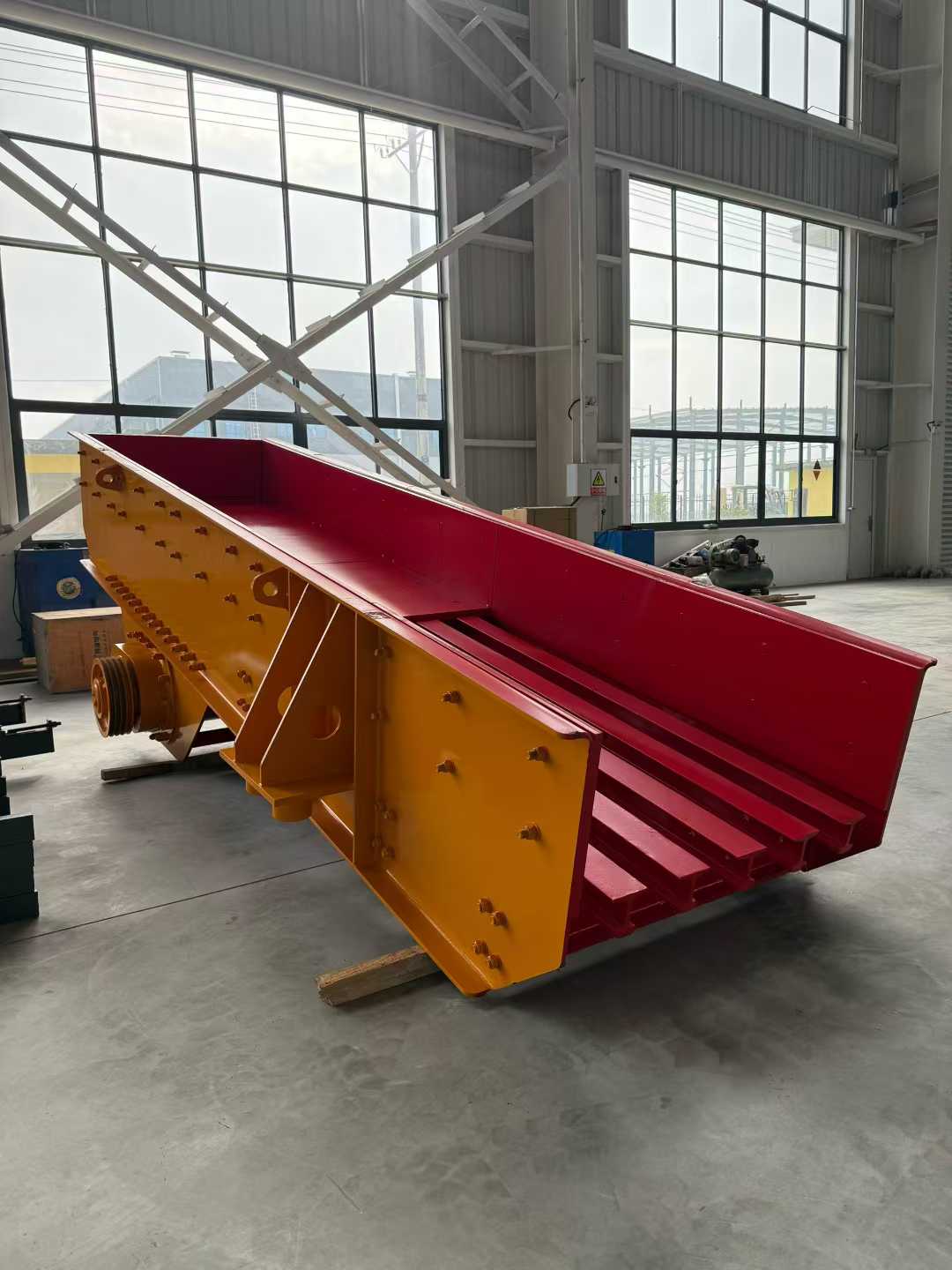
Hoisting: Use a crane to place the equipment gently, avoid hitting the springs
Initial Positioning: Align the feeder trough centerline with the downstream crusher feed inlet (deviation <5 mm)
Leveling: Use a frame level to adjust longitudinal and transverse levels of the trough (<2 mm per meter)
Fixing: Tighten anchor bolts, but not fully—leave room for final adjustments
Spring Adjustment Key Points:
Four spring seats must be at the same height (diagonal difference <3 mm)
Pre-compression must be sufficient (press down 3–5 mm); too loose → wobble, too stiff → poor vibration
7.3 Electrical Wiring – "Wrong Phase Sequence Ruins Everything"
Key: Both motors must rotate in opposite directions!
Wiring Method:
Motor 1: U-V-W
Motor 2: U-W-V (swap two phases)
Or check rotation marks, ensure one clockwise, one counterclockwise
Verification:
Jog the motors briefly; observe if the trough vibrates linearly front-to-back or rotates/oscillates
Linear vibration = correct
Circular or chaotic vibration = phase sequence wrong, swap wires
Protection Configuration:
Install thermal relays or motor protectors; overload stops automatically
Interlock with downstream crusher: crusher starts first, feeder can start; crusher stops, feeder stops first
7.4 No-Load Test – "Run Empty Before Loading"
Three Test Stages:
| Stage | Duration | What to Check | Standard |
|---|---|---|---|
| Jog | Few seconds | Rotation, noise | Correct rotation, no impact |
| Short Run | 5 minutes | Current, vibration | Stable current < rated, smooth vibration |
| Continuous | 2 hours | Temperature, fasteners | Motor <40℃, bolts tight |
Amplitude Measurement (Simple Method):
Use a vibration meter or stand a coin on the trough edge, observe jump height
Or draw a chalk line on the trough side, width of blurred mark ≈ double amplitude
Both sides must have similar amplitude; large differences require eccentric block adjustment
7.5 Load Test – "Step by Step"
Feeding Principle:
Half load (50%), stabilize for 30 min
75% load, stabilize for 30 min
Full load, continuous operation for 4 hours
Observation Focus:
| Item Observed | Good Phenomenon | Bad Phenomenon | Adjustment Method |
|---|---|---|---|
| Feeding rate | Stable, meets design value | Fluctuates | Adjust amplitude or incline |
| Material flow | Evenly covers trough bottom | Fast in middle, slow at edges, or piling | Level trough, check hopper discharge |
| Vibration | Smooth front-to-back shake | Lateral sway, vertical jumping | Adjust springs, check anchors |
| Motor current | Stable, needle steady | Large fluctuations, occasional spikes | Check for jamming, particle size |
| Noise | Even humming | Metal impact, sharp screeching | Stop and check, possible loose bolts or bearings |
7.6 Common Installation Mistakes – Top Ranking
| Rank | Mistake | Consequence | Prevention |
|---|---|---|---|
| 1 | Uneven or weak foundation | Feeder jumps, anchor bolts break, foundation cracks | Build foundation per drawings, inspect before installation |
| 2 | Uneven spring heights | Trough twist, bearing uneven load, spring breaks | Level carefully with a spirit level, all four feet equal |
| 3 | Motor phase sequence reversed | Feeder vibrates irregularly or rotates, cannot operate | Jog test, check movement path |
| 4 | Anchor bolts not tightened | Equipment shifts, pipelines damaged, strong vibration | Regular checks, use spring washers to prevent loosening |
| 5 | Unequal eccentric block adjustment | Different amplitudes, material runs off-center | Both sides must match, use protractor |
| 6 | Loading full material in one go | Motor overload, mechanical shock | Step by step, start no-load, then feed gradually |
7.7 Acceptance Checklist (Simplified)
Foundation flatness acceptable (measured with level)
Equipment centerline aligned (measured with tape)
Trough leveled (per meter <2 mm)
Spring pre-compression uniform (visual + hand check)
Motor rotation correct (observed during jog)
No-load operation for 2 hours without issues
Load operation 4 hours, current stable
Feeding rate meets design value
Noise <75 dB (or acceptable on site)
All bolts tightened, anti-loosening marks applied
Conclusion
ZW feeder installation is not complicated, but details determine success. Ensure a solid foundation, level equipment, uniform springs, and correct wiring. Do not rush commissioning—progress step by step. Follow these guidelines, and your equipment will run reliably for years.
Next Preview:
"How to Adjust Output? ZW Feeder On-Site Adjustment Techniques"