Heavy Duty Apron Feeder | Plate Chain Feeder

Professional Mining Feed Equipment Manufacturer | ISO9001 & CE Certified

What is an Apron Feeder?

An apron feeder (also known as plate feeder, plate chain feeder, or heavy duty plate feeder) is a continuous conveying equipment driven by chains with metal pans for material transport. Widely used in mining, metallurgy, cement, construction materials, and coal industries, it is specifically designed for uniform feeding from storage bins to jaw crushers, impact crushers, and cone crushers, particularly suitable for handling large lumps, high-temperature, and highly abrasive materials.

Working Principle & Technical Specifications

How Apron Feeders Work

An electric motor drives the system through a reducer gearbox, transmitting power to the drive sprocket, which pulls the high-strength forged chains (pitch 228.6mm) or long-pitch plate pin roller chains (pitch 152.4mm, 200mm, 216mm, 250mm). The pans carry materials in continuous motion, with operating speeds typically ranging from 0.02–0.4 m/s. Feed rate is precisely controlled through gate opening adjustment or variable frequency drive (VFD).

Key Structural Components

  • Traction Chains: High-strength forged chains or dozer track chains (216MA/228.6mm pitch), breaking load ≥180 tons
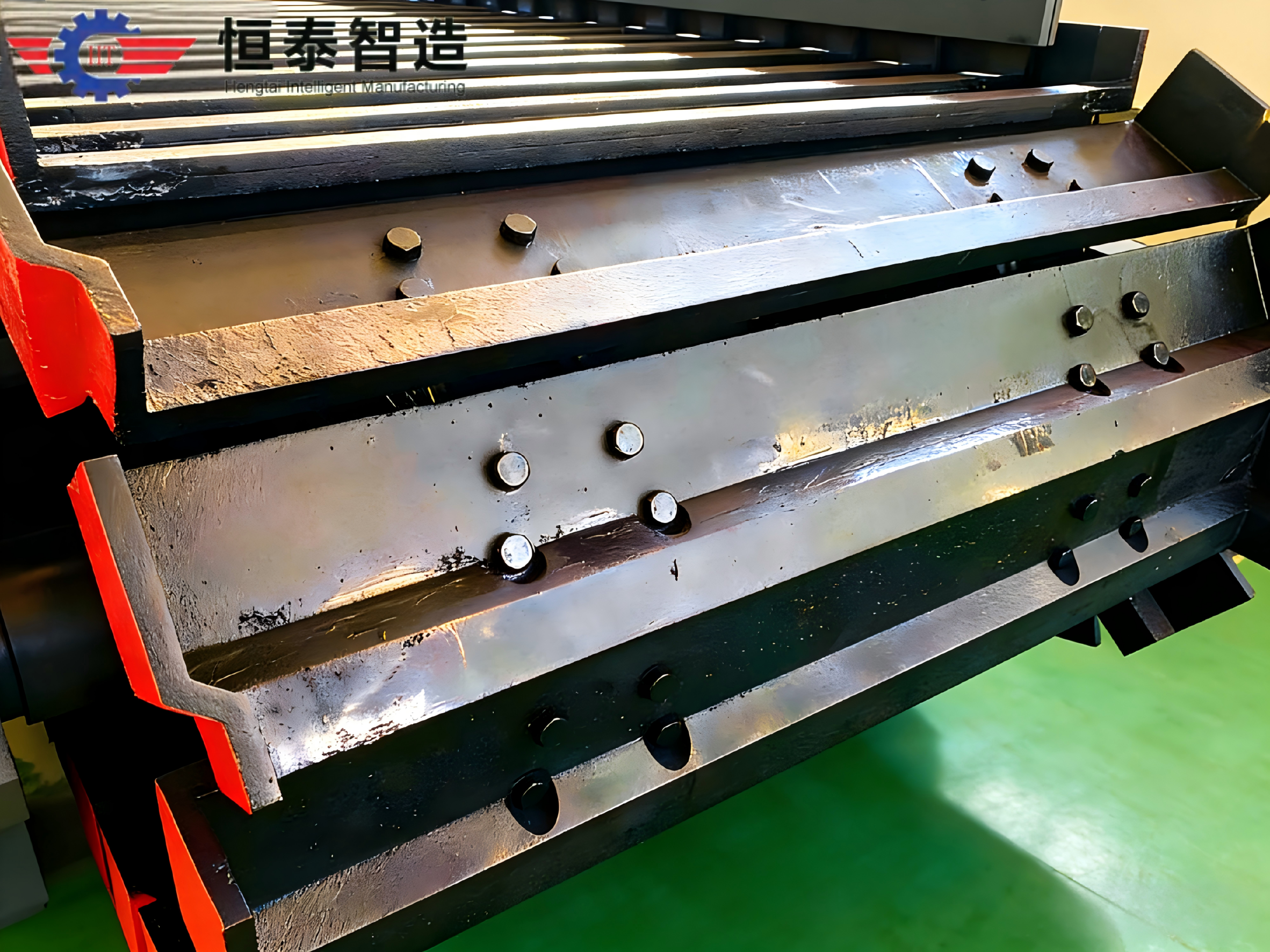
  • Carrying Pans: 16Mn high manganese steel welded structure, 16–20mm thickness, wear and impact resistant
  • Support/Track Rollers: ZG40Cr alloy cast steel, HRC48–55 hardness, sealed rolling bearing construction
  • Drive Unit: Variable frequency motor + hardened gearbox, hydraulic motor drive optional
  • Tensioning Device: Tail screw tensioning, 350–500mm stroke, with composite spring impact buffering

Product Gallery

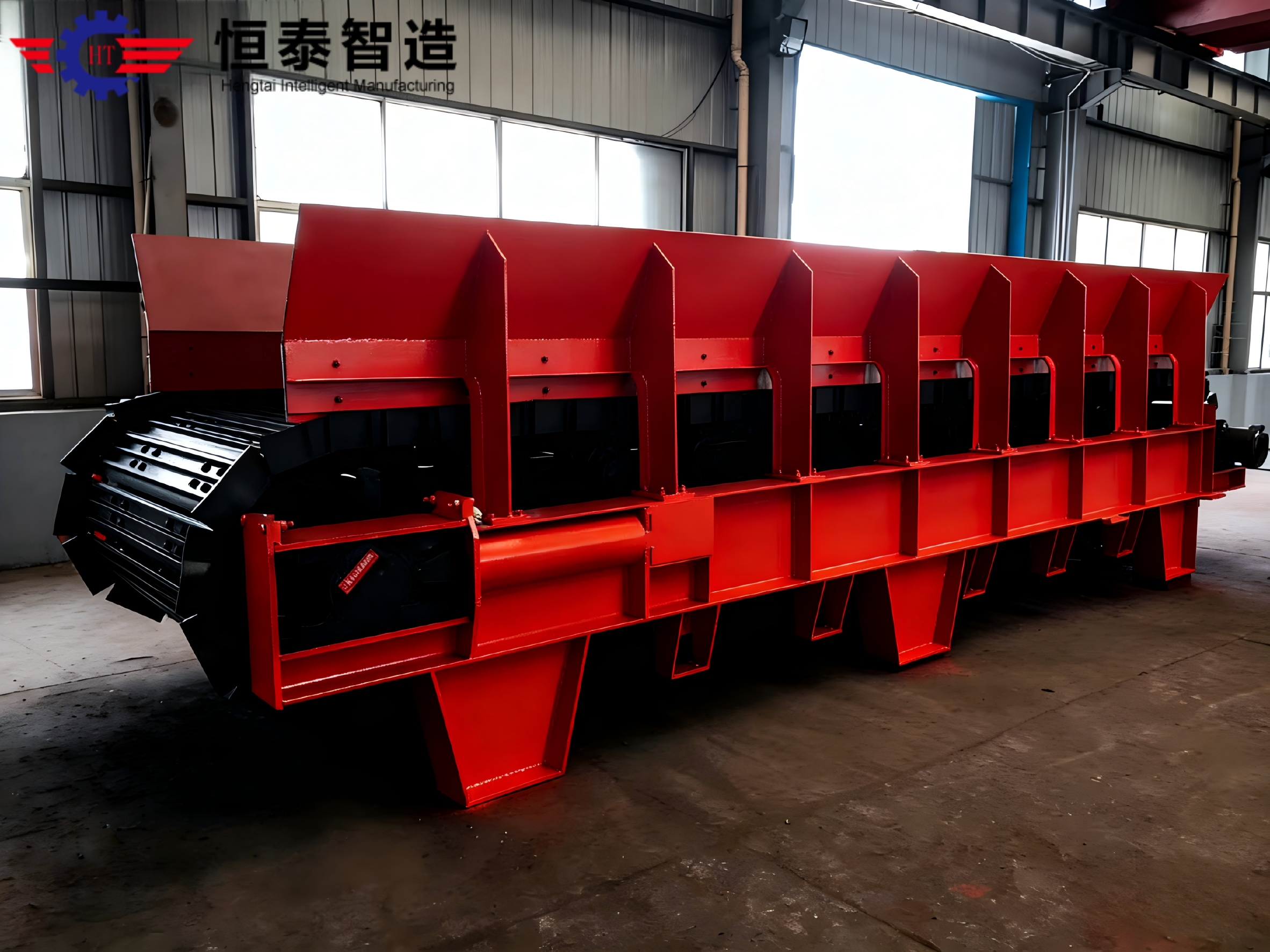
Heavy Duty Apron Feeder - Overall Appearance View
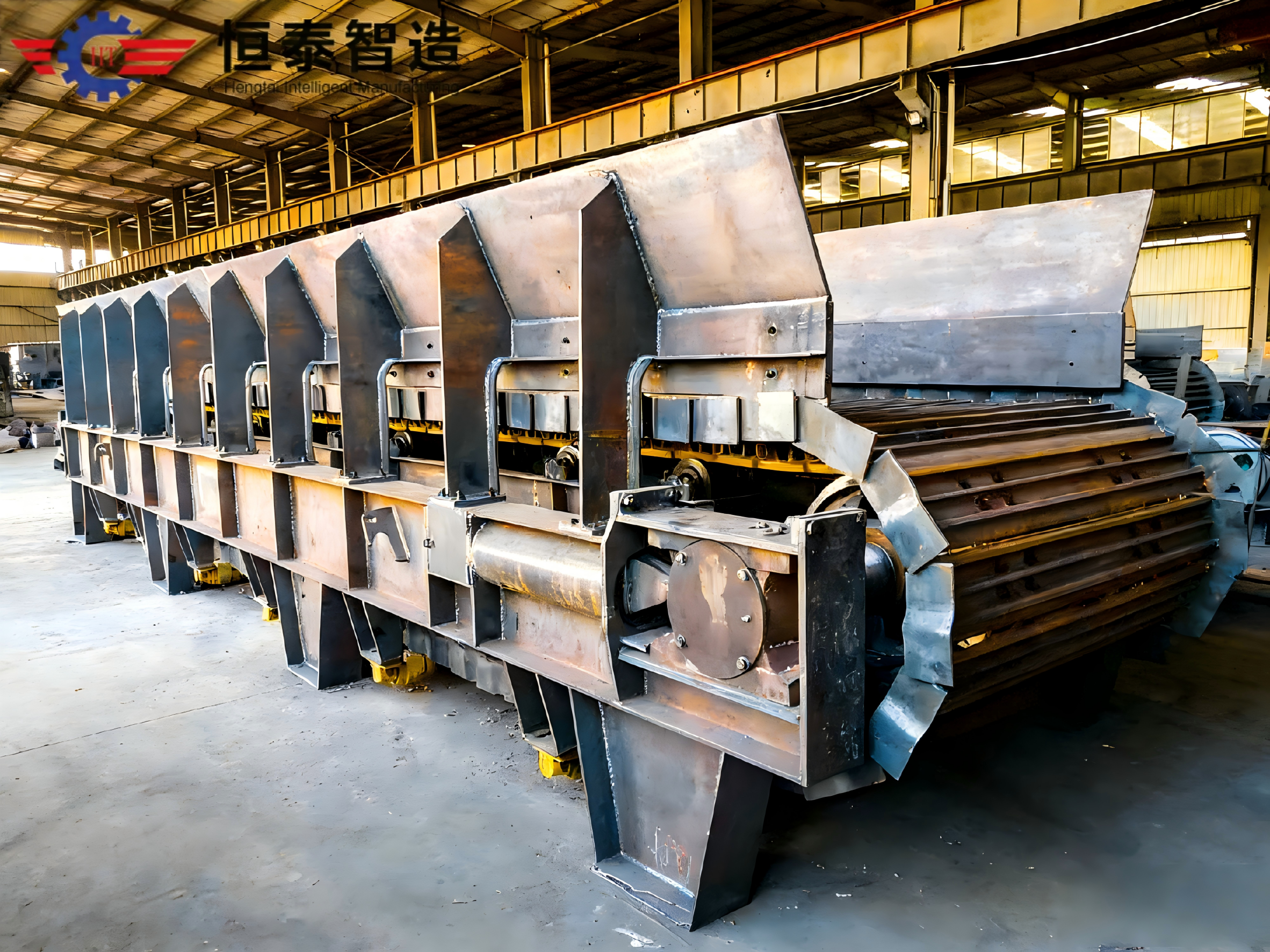
Heavy Duty Apron Feeder - Working Scene in Mining Site
Heavy Duty Apron Feeder - Core Components Detail
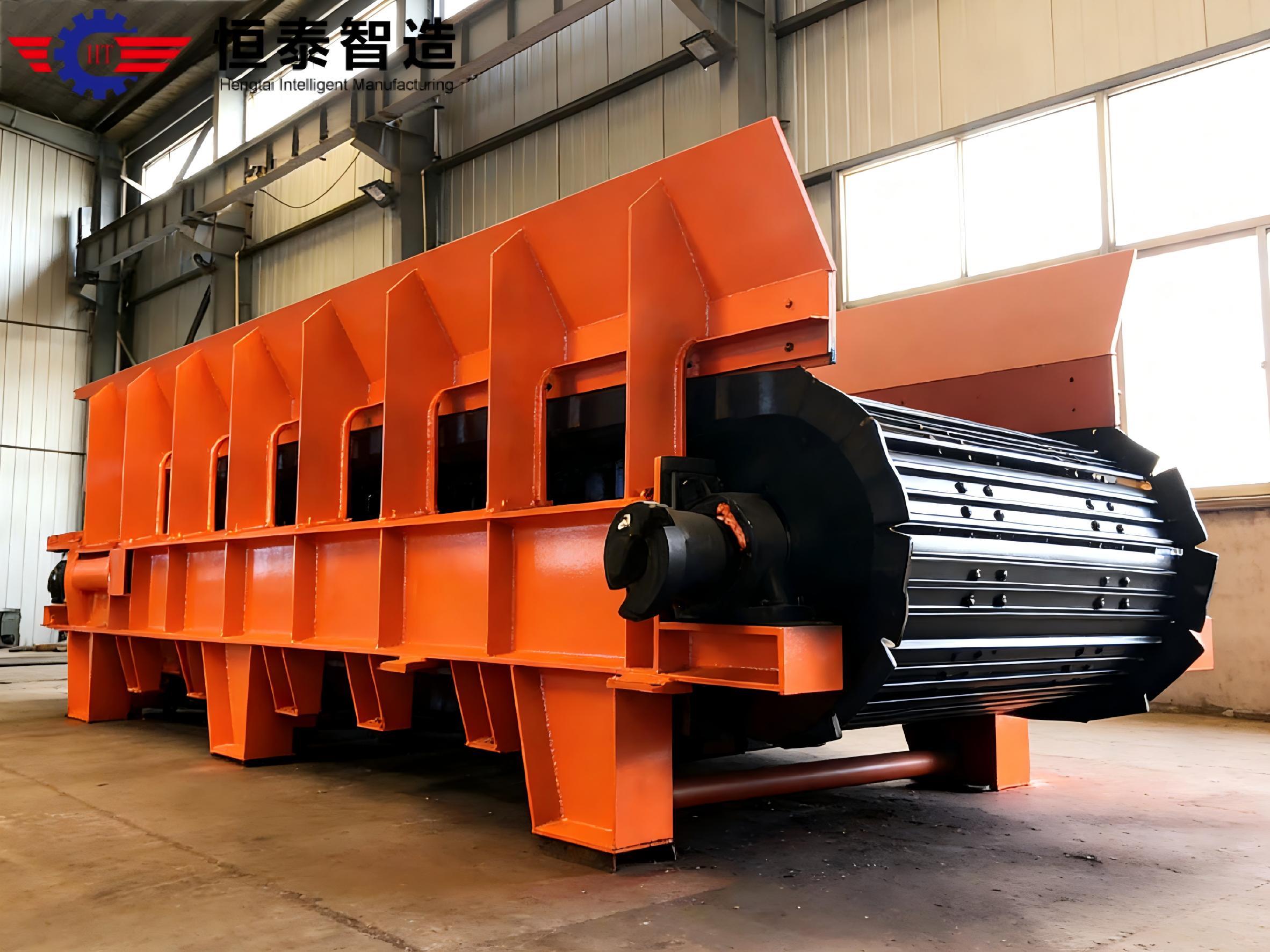
Heavy Duty Apron Feeder - Industrial Application Site

Equipment Operation Video

Heavy Duty Apron Feeder Technical Specifications (L Series)

Model Pan Width (mm) Center Distance (m) Max Feed Size (mm) Capacity (t/h) Motor Power (kW) Weight (t) Overall Dimensions (mm)
BW80-L8003–15≤3500.2–752.23.53200×1000×850
BW100-L10003–18≤60018–3505.5–18.56.83500×1200×920
BW120-L12004–20≤60030–22011–18.59.24000×1400×1050
BW125-L12504–20≤80040–2501110.54200×1450×1100
BW140-L14005–20≤90040–2002213.84500×1600×1180
BW150-L15005–20≤90040–30022–3015.34800×1700×1250
BW160-L16006–20≤90027–30030–3717.65000×1800×1320
BW180-L18006–20≤97030–35022–5521.55200×2000×1450
BW200-L20008–20≤1500300–8004528.76000×2200×1600

Note: Center distance, pan material, and conveying capacity can be customized according to site requirements. Actual capacity depends on material characteristics, operating speed, and installation angle.

Apron Feeder Classification & Applications

By Load Capacity

Type Bulk Density Max Lump Weight Temperature Typical Applications
Light Duty≤1,200 kg/m³≤140 kg≤350°CSmall-to-medium mines, building materials plants
Medium Duty≤2,400 kg/m³≤500 kg≤400°CCement plants, aggregate production lines
Heavy Duty>2,400 kg/m³>500 kg≤450°CLarge metal mines, primary crushing feed

Primary Applications

  • Mining Industry: Uniform feeding from raw ore bins to jaw crushers and gyratory crushers
  • Cement & Construction Materials: Limestone primary crushing feed, clinker and aggregate conveying
  • Metallurgy Industry: High-temperature sinter, pellet conveying, steel plant raw material handling
  • Coal & Chemical: Coal lump, coke, and chemical material feeding
  • Port & Logistics: Bulk cargo terminal loading/unloading, stockpile reclaiming operations

Apron Feeder vs. Vibrating Feeder: How to Choose?

Feature Heavy Duty Apron Feeder Vibrating Feeder
Max Feed SizeUp to 1,500mmTypically ≤600mm
Impact ResistanceExcellentLimited
Wear Resistance3–5 year lifespanFaster wear
Temperature HandlingUp to 450°C≤200°C
Best ForLarge-scale miningMedium-to-fine crushing

Apron Feeder Selection Guide: Key Parameters & Factors

5 Critical Selection Factors

  • Material Characteristics: Maximum lump size, density, hardness, abrasiveness, moisture content, temperature
  • Process Requirements: Design capacity, feeding uniformity, installation angle, equipment integration
  • Equipment Specification: Pan width, center distance, chain specifications, motor power
  • Drive & Control: Variable frequency motor, hydraulic motor drive, left/right hand drive
  • Special Conditions: Outdoor operation, underground mining, sticky materials adaptation

Quality Assurance & Manufacturing Standards

Quality Management System

  • ISO 9001:2015 Quality Management System certified
  • CE Certification (European market)
  • Material traceability with Mill Test Certificates (MTCs)

Patented Technical Features

  • Segmented Sprocket Design: Split structure for easy replacement
  • Composite Spring Tensioning Device: Automatic chain elongation compensation
  • Labyrinth Seal Structure: Maintenance-free bearings, dust and water protection
  • Keyless Connection Technology: Expansion sleeve connection, shaft damage prevention

Frequently Asked Questions (FAQ)

Q: Can heavy duty apron feeders operate 24/7 continuously?

A: Absolutely. The equipment is specifically engineered for harsh operating conditions, suitable for high-load, long-term continuous operation. Equipment can operate stably for 3–5 years without major overhaul.

Q: How is feeding uniformity ensured?

A: The BW series adopts variable frequency speed control, with speeds adjustable from 0.02–0.4 m/s, achieving continuous and uniform feeding. This effectively prevents crushers from experiencing "starvation or overfeeding".

Q: How often do chains and pans need replacement?

A: Under normal operating conditions, chains have a 3–5 year lifespan. Monthly bolt tightness checks, quarterly chain elongation measurements, and annual professional inspections are recommended.

Q: Can the equipment adapt to open-pit mining environments?

A: Yes. Equipment receives multi-layer painting before delivery. Chains should be cleaned with diesel weekly for rust prevention, and bearings feature labyrinth seals, fully adapting to outdoor, humid, and dusty environments.

Compatible Equipment & System Integration

Heavy-duty apron feeders can be integrated with various crushing and screening equipment to form complete material handling systems. The following combinations are commonly used in mining and aggregate processing plants:

Equipment Combination Function & Working Principle Application Scenarios & Benefits
Apron Feeder + Jaw Crusher
Primary Crushing Line
Apron feeder serves as front-end feeding equipment for crushers, ensuring uniform material feeding into the crushing chamber. Prevents crusher overload and material blockage by controlling feed rate through variable frequency drive. Ideal for: Large-scale mining operations, quarry primary crushing stages.
Benefits: Protects crusher from damage caused by uncontrolled material surge; extends crusher wear parts lifespan by 30-40%; ensures continuous stable production with uniform feed rate.
Apron Feeder + Impact Crusher/Cone Crusher
Secondary/Tertiary Crushing
Feeder transports pre-screened or primary crushed material to secondary crushers. Maintains consistent feed rate for optimal crushing efficiency and product shape. Ideal for: Medium to hard rock processing, construction aggregate production.
Benefits: Prevents crusher cavity blockage; maximizes crusher throughput; reduces energy consumption per ton by maintaining stable load.
Apron Feeder + Vibrating Screen
(or Trommel Screen)
Screening & Classification
Feeder provides stable, controlled material flow to vibrating screens or trommel screens for particle size classification. Ensures uniform distribution across screen surface for efficient separation. Ideal for: Aggregate grading, ore pre-screening, construction material classification.
Benefits: Improves screening efficiency by 20-25%; prevents screen blinding caused by uneven feed; extends screen mesh lifespan; ensures accurate particle size separation.
Apron Feeder + Belt Conveyor
Long-Distance Transport
Apron feeder receives material from bins or trucks and transfers it to belt conveyor systems. Handles high-impact loading while belt conveyor manages long-distance or inclined/horizontal transport. Ideal for: Stockpile reclaiming, port loading, plant material transfer, overland conveying.
Benefits: Apron feeder handles high-drop impact; belt conveyor provides cost-effective long-distance transport; seamless integration reduces transfer point spillage; suitable for high-capacity continuous operation.
Complete System:
Apron Feeder + Crusher + Screen + Conveyor
Integrated Production Line
Apron feeder as the front-end feeding unit, integrated with primary crusher, vibrating screen, and belt conveyor to form a complete crushing and screening production line. Ideal for: Large quarry operations, mining processing plants, construction aggregate production.
Benefits: One-stop material handling solution; high automation level; reduced manual intervention; maximum production efficiency with capacity up to 1000+ t/h.

System Integration Services: We provide complete production line design and equipment integration services. Our engineers can customize the optimal equipment combination based on your material characteristics, capacity requirements, and site conditions. From single equipment supply to complete EPC solutions, we support your project at every stage.

Request Detailed Solution & Quote

Shandong Hengtai Intelligent Manufacturing Equipment Technology Co., Ltd.

Tel/WhatsApp: +86 182 8866 4797

Email: ht6234nibin@gmail.com

Address: Intelligent Equipment Manufacturing Industrial Park, High-Tech Zone, Linyi City, Shandong Province, China

Service Commitment: Equipment Selection | Customized Solutions | Installation Guidance | Lifetime Support

Heavy-duty apron feeder requires professional design based on your material characteristics and working conditions. Welcome to inquire or visit our factory.