200 TPH Limestone Crushing Plant: Complete Equipment Selection Guide & 4 Configuration Options (2026)
200 TPH Limestone Crushing Plant: Complete Equipment Selection Guide & 4 Configuration Options (2026)
200 TPH Limestone Crushing Plant: Jaw, Impact, Hammer & Mobile Configurations | Equipment Selection Guide
Table of Contents
<a name="section-1">
1. Limestone Material Properties & Selection Logic
Limestone is a medium-to-soft brittle material with typical characteristics:
Protodyakonov hardness: f = 3–6 (dense or silicified layers may reach f = 8)
Uniaxial compressive strength (UCS): commonly 30–150 MPa; some dense varieties exceed 200 MPa
** abrasiveness:** Low to moderate; silica content directly affects wear part life
For a 200 tonnes per hour (TPH) production target, equipment selection must answer three questions:
End-product use: Road base, concrete aggregate, or cement plant feed?
Feed conditions: Maximum feed size, moisture content, and clay content?
Site constraints: Fixed long-term quarry or temporary/multi-site projects?
<a name="section-2">
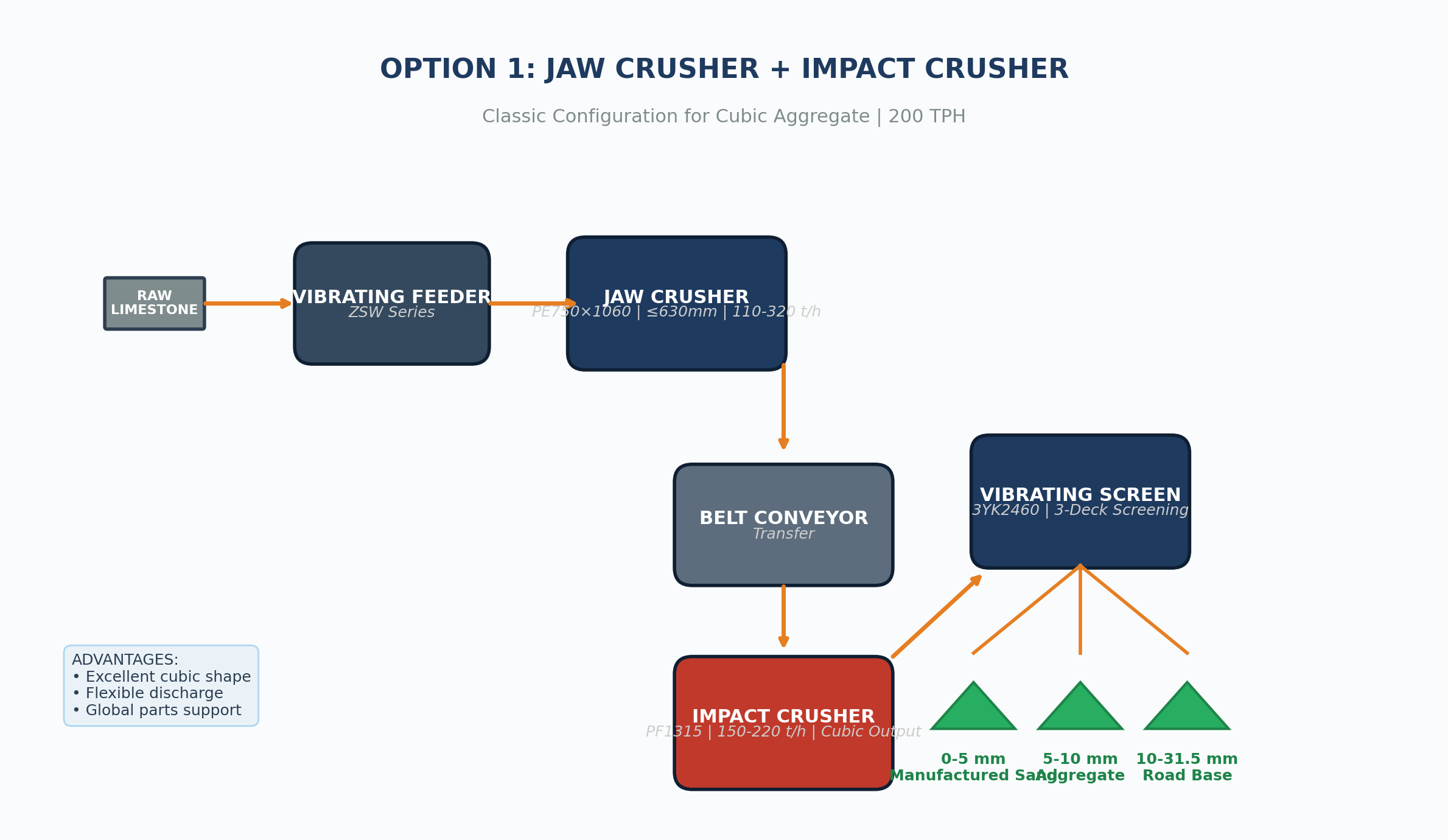
2. Option 1: Jaw Crusher + Impact Crusher (Classic Soft-Rock Configuration)
This is the most widely adopted two-stage flow for limestone worldwide, balancing capacity, cubic product shape, and parts availability.
Recommended Equipment List
| Stage | Equipment | Key Specifications | Qty |
|---|---|---|---|
| Primary Crushing | PE750×1060 Jaw Crusher | Feed opening ≤630 mm; Capacity 110–320 t/h | 1 unit |
| Secondary/Tertiary | PF1315 Impact Crusher | Capacity 150–220 t/h (soft limestone); Cubic output | 1 unit |
| Screening | 2YK2460 / 3YK2460 Vibrating Screen | 3-deck; Fractions 0–5, 5–10, 10–31.5 mm | 1–2 units |
| Auxiliary | ZSW Vibrating Feeder, Belt Conveyors, Dust Collection | — | As required |
Why This Configuration?
Superior particle shape: Impact crushing produces excellent cubic aggregates with low flake content, meeting high-grade road and airport runway standards.
Flexible adjustment: Discharge size is easily controlled by adjusting the impact plate gap.
Proven global supply chain: PE and PF series are universal models with readily available spare parts in most markets.
Best For
Fixed stationary plants producing concrete aggregate, asphalt mix, and road base materials from clean limestone with moderate silica content.
<a name="section-3">
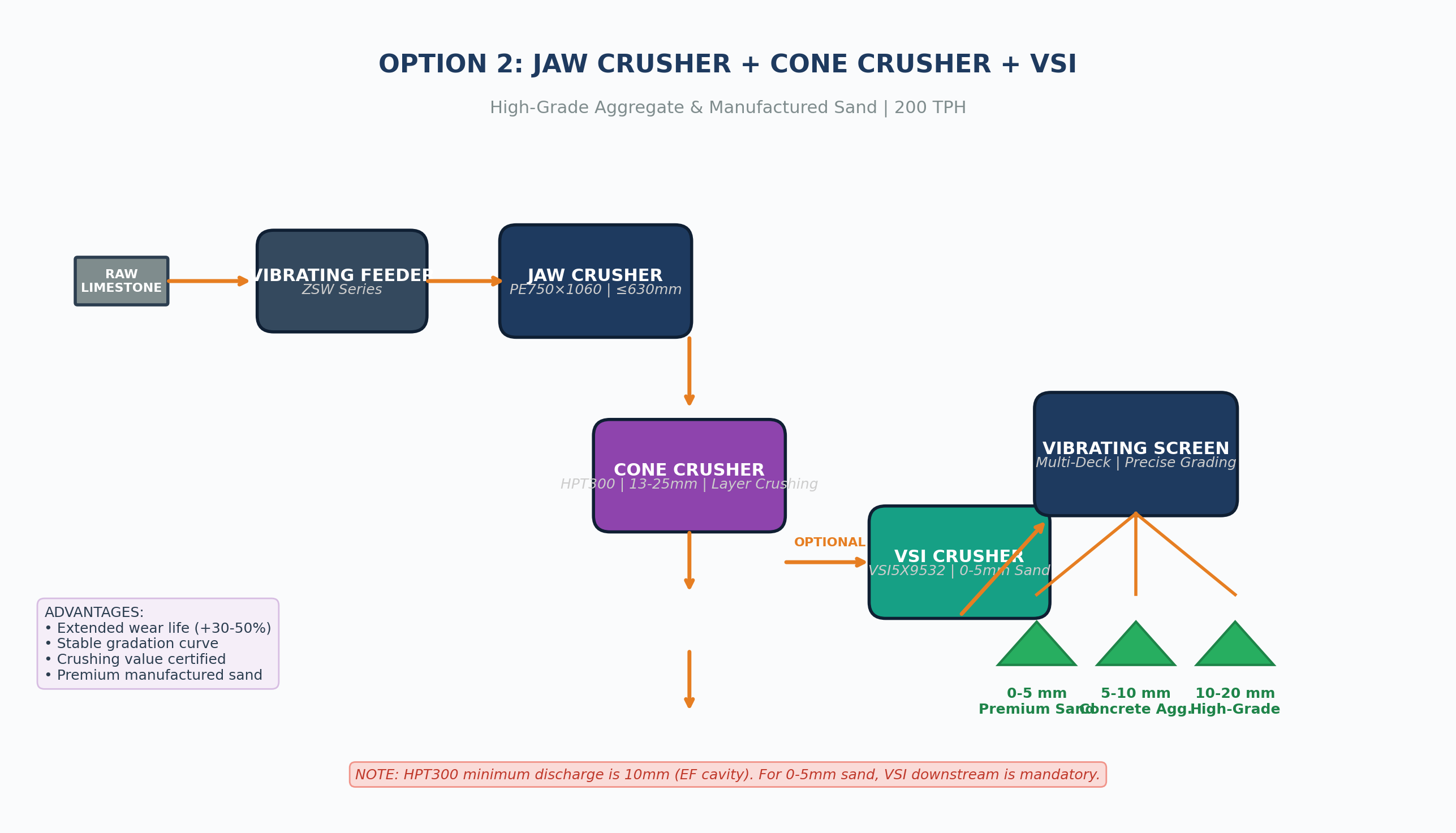
3. Option 2: Jaw Crusher + Multi-Cylinder Cone Crusher (High-Specification Aggregate)
When the limestone deposit contains chert nodules or when the project demands strict flakiness index, crushing value, and gradation curves (e.g., high-grade ready-mix concrete), a cone crusher offers better wear resistance and gradation control.
Recommended Equipment List
| Stage | Equipment | Key Specifications | Qty |
|---|---|---|---|
| Primary Crushing | PE750×1060 Jaw Crusher | Reliable front-end feed capacity | 1 unit |
| Secondary/Tertiary | HPT300 Multi-Cylinder Hydraulic Cone Crusher | Discharge opening: 10 mm minimum (EF cavity); Typical range 13–25 mm | 1–2 units |
| Sand Making (Optional) | VSI5X9532 Vertical Shaft Impact Crusher | Shaping 0–5 mm manufactured sand | 1 unit |
| Screening | Multi-deck Vibrating Screen | Precise classification | As required |
Important Clarification
The HPT300 cone crusher cannot produce 0 mm discharge. Its minimum closed-side setting is approximately 10 mm (EF ultra-fine cavity). For 0–5 mm manufactured sand, a VSI vertical shaft impactor must be added downstream.
Why This Configuration?
Extended wear life: Laminated crushing action reduces mantle and bowl liner consumption by 30–50% compared to impactors when processing abrasive feeds.
Stable gradation: Hydraulic CSS adjustment maintains consistent product size distribution.
Sand integration: The "Jaw + Cone + VSI" three-stage flow produces premium manufactured sand and concrete aggregate simultaneously.
Best For
Projects requiring premium concrete aggregate with certified crushing values, or limestone deposits with intermittent hard silica inclusions.
<a name="section-4">
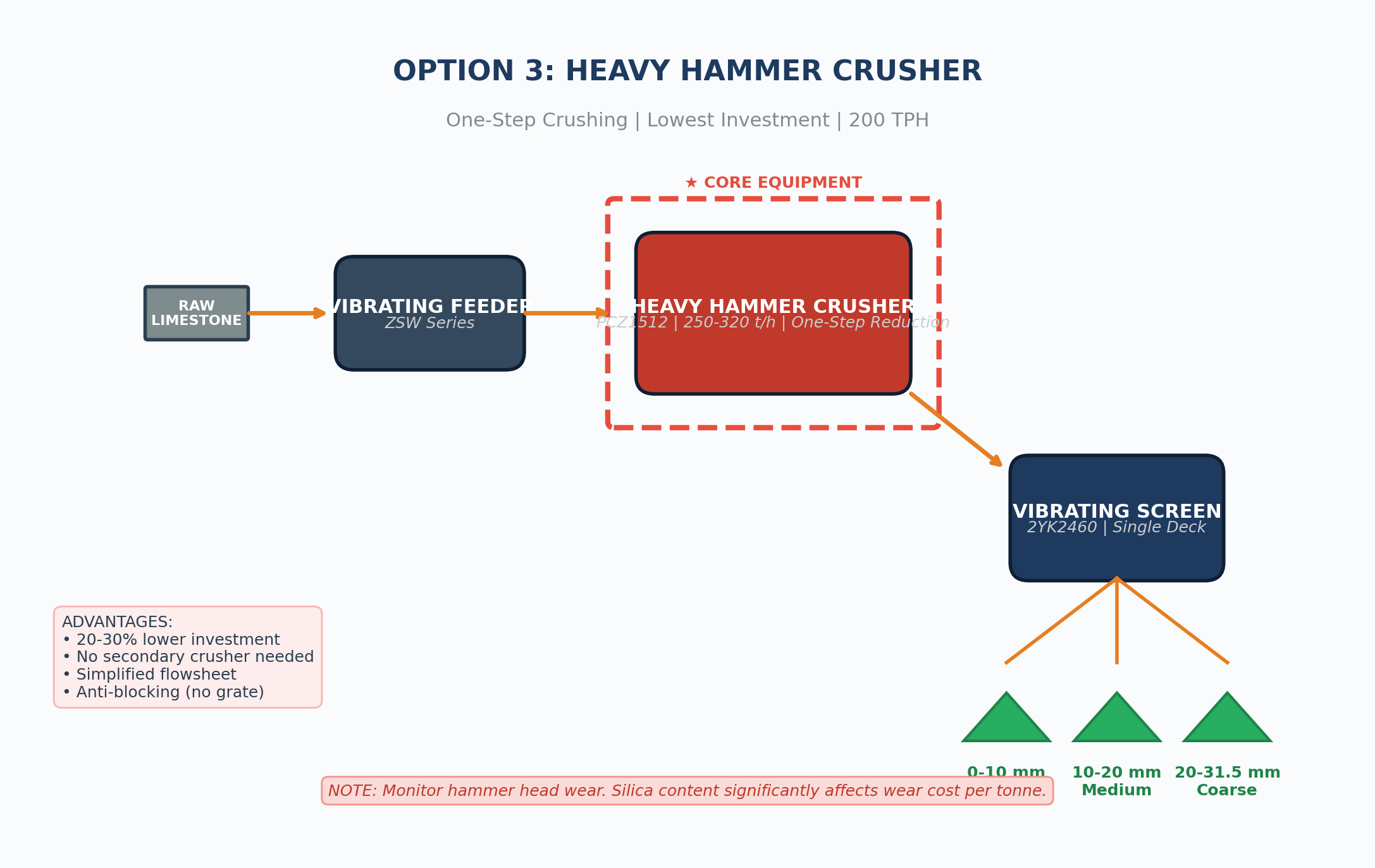
4. Option 3: Heavy Hammer Crusher (One-Step Crushing, Low Investment)
For budget-sensitive projects where end-use is cement plant feed, road sub-base, or backfill, a heavy hammer crusher replaces both jaw and impact stages in a single machine.
Recommended Equipment List
| Stage | Equipment | Key Specifications | Qty |
|---|---|---|---|
| Primary/Secondary | PCZ1512 Heavy Hammer Crusher | Capacity 250–320 t/h; Single-stage reduction | 1 unit |
| Screening | Vibrating Screen | Product fractions separation | 1 unit |
| Auxiliary | Feeder, Belt Conveyors, Dust Suppression | — | As required |
Why This Configuration?
Lower capital expenditure: Eliminating the secondary crushing stage reduces equipment count and civil foundation costs by approximately 20–30%.
Anti-blocking design: Non-grate bar designs handle slightly wet or sticky limestone without choking.
Simplified flowsheet: One crusher from ≤700 mm feed to finished product reduces operational complexity.
Limitations
Wear part monitoring: Hammer heads require periodic replacement; silica content significantly affects wear cost per tonne.
Particle shape: Cubicity is slightly inferior to impact crusher output; verify specifications if used for high-grade asphalt or concrete.
<a name="section-5">
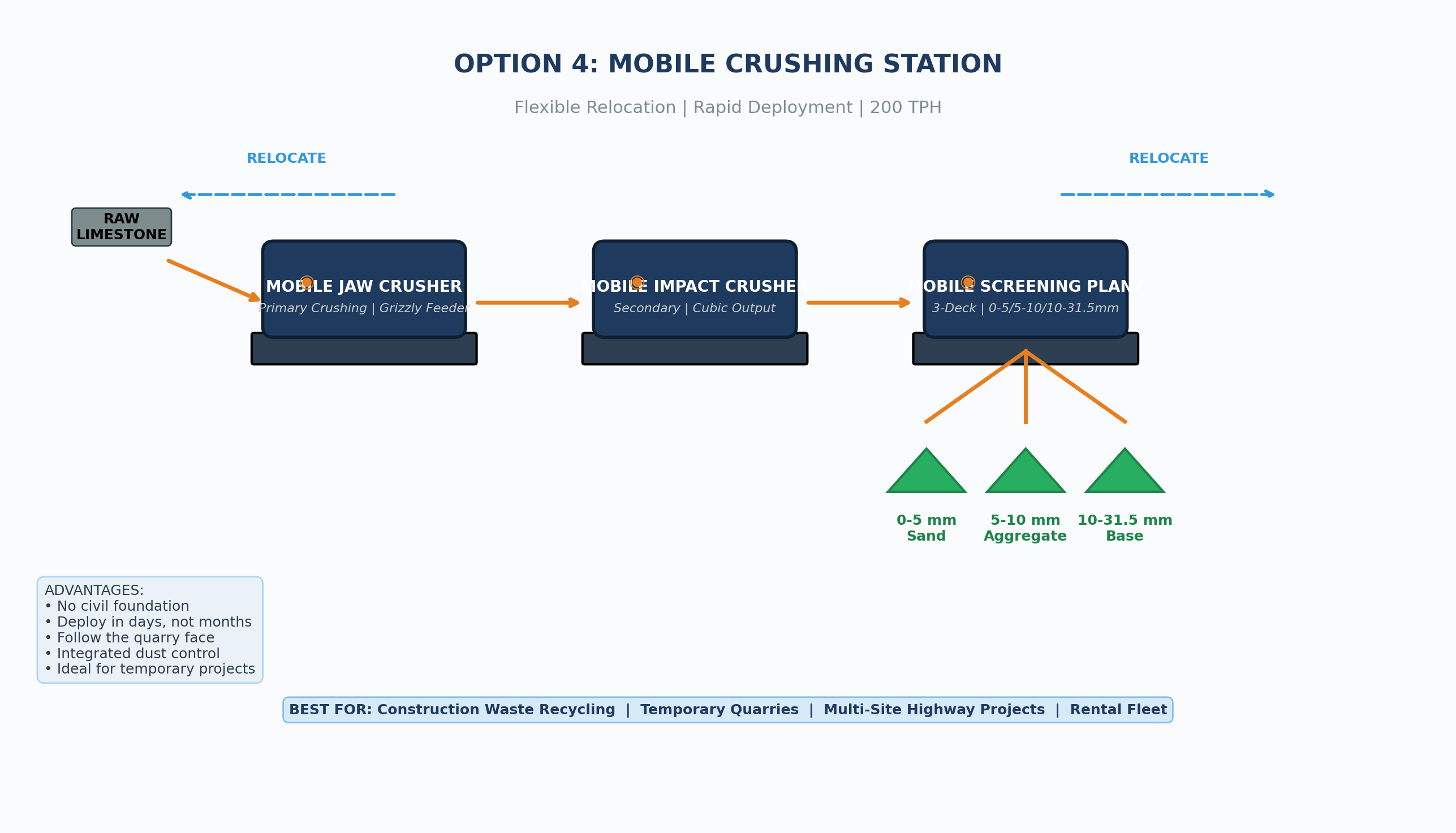
5. Option 4: Mobile Crushing Station (Flexible Relocation)
For temporary quarrying, construction waste recycling, or multi-segment highway projects, a mobile train eliminates concrete foundations and enables rapid site relocation.
Recommended Configuration
| Unit | Function |
|---|---|
| Mobile Jaw Crusher Station | Tracked or wheeled chassis with integrated grizzly feeder; primary reduction |
| Mobile Impact Crusher Station | Secondary crushing on tracks/wheels; produces cubic aggregate |
| Mobile Screening Station | 3-deck inclined screen; simultaneous output of 0–5, 5–10, 10–31.5 mm |
Why This Configuration?
Rapid deployment: No civil foundations required; production can begin within days of arrival.
Reduced haulage: Move the crusher to the face rather than trucking feed to a fixed plant.
Environmental compliance: Integrated dust suppression and noise reduction systems satisfy strict temporary project permits.
Best For
Construction waste recycling, short-term quarry leases, rental fleet operations, and fast-track EPC projects requiring immediate aggregate output.
<a name="section-6">
6. Configuration Comparison Matrix
| Criteria | Option 1: Jaw + Impact | Option 2: Jaw + Cone | Option 3: Heavy Hammer | Option 4: Mobile Station |
|---|---|---|---|---|
| Primary Advantage | Best cubic shape | Best wear life & gradation | Lowest investment | Maximum flexibility |
| Capital Investment | Medium | Higher | Lowest | Higher (no civil cost) |
| Power Consumption | Medium | Medium-low | Lower | Slightly higher |
| Product Shape | ⭐⭐⭐⭐⭐ | ⭐⭐⭐⭐☆ | ⭐⭐⭐☆☆ | ⭐⭐⭐⭐☆ |
| Feed Hardness | Soft to medium | Medium with hard inclusions | Soft limestone | Soft to medium |
| Maintenance | Low | Medium | Low (monitor hammers) | Medium |
| Best Application | High-grade aggregate | Premium concrete sand | Cement feed / sub-base | Temporary / multi-site |
<a name="section-7">
7. Critical Selection Factors
7.1 Material Characteristics
Limestone's low hardness and brittleness make impact crushers and hammer crushers inherently more efficient than cone crushers. If feed moisture exceeds 8% or clay content is high, prioritize non-grate heavy hammer crushers or pre-screening grizzly feeders to prevent screen blinding.
7.2 Product Specifications
| End Product | Recommended Option | Key Equipment |
|---|---|---|
| Concrete aggregate 0–5/5–10/10–31.5 mm | Option 1 or 2 | Impact crusher or Cone crusher + precise screening |
| Cement plant raw meal | Option 3 | Heavy hammer crusher single stage |
| Manufactured sand 0–5 mm | Option 2 + VSI | Cone crusher + vertical shaft impactor |
| Road base / fill | Option 1 or 3 | Impact crusher or heavy hammer crusher |
7.3 Operational Horizon & Site
Fixed quarry (>5 years): Options 1, 2, or 3 deliver the lowest cost per tonne.
Short-term or dispersed sites: Option 4 avoids stranded fixed assets.
<a name="section-8">
8. ROI and Operating Cost Analysis
Based on 200 TPH × 3,000 hours/year operation:
| Cost Item | Option 1 (Jaw + Impact) | Option 3 (Heavy Hammer) | Option 4 (Mobile) |
|---|---|---|---|
| Initial Investment | Medium | Low (20–30% lower) | Higher (but no civil works) |
| Power Consumption (whole plant) | 1.5–2.5 kWh/tonne | 1.2–2.0 kWh/tonne | 2.0–3.0 kWh/tonne |
| Wear parts per tonne | Medium (blow bars + jaw plates) | Slightly higher (hammer heads) | Similar to stationary |
| Labor per shift | 3–4 operators | 2–3 operators | 2–3 operators |
| Payback Period | 1.5–2.5 years | 1.0–1.8 years | 1.2–2.0 years (rental shorter) |
<a name="section-9">
9. Frequently Asked Questions (FAQ)
Q1: What is the minimum site area required for a 200 TPH fixed limestone plant?
A fixed configuration (Options 1–3) typically requires a rectangular footprint of 60 m × 40 m minimum, including equipment bays, finished product stockpiles, and truck turning circles. A mobile train occupies roughly 15 m × 10 m per unit but requires haul road access for relocation.
Q2: Is pre-screening necessary for limestone crushing?
If surface soil or clay content exceeds 5%, install a grizzly feeder (bar screen) ahead of the jaw crusher. This protects the crusher, reduces wear, and improves final product cleanliness.
Q3: Impact crusher or heavy hammer crusher—which is better for limestone?
Choose an impact crusher when premium cubic aggregate for concrete or asphalt is required and budget allows. Choose a heavy hammer crusher when minimizing initial investment is the priority and the product is used for cement feed or road base.
Q4: Can a mobile plant match the capacity and reliability of a stationary plant?
Modern tracked and wheeled plants use the same crusher boxes as stationary units. A 200 TPH mobile train can absolutely match fixed-plant output. The difference lies in feed hopper volume and continuous feeding logistics—mobile sets excel when feed sources are dispersed.
Q5: What special considerations apply for overseas projects in hot or humid climates?
Specify electric motors with IP55 minimum protection and tropicalized insulation. For high-humidity regions, consider stainless-steel screen media and sealed bearing housings to prevent corrosion.
<a name="section-10">
10. Conclusion & Next Steps
For a 200 TPH limestone crushing project:
First recommendation: Option 1 (PE750×1060 Jaw + PF1315 Impact)—technically mature, excellent particle shape, and globally supported spare parts make this the safest choice for export and long-term quarry operations.
Budget-sensitive projects: Option 3 (PCZ1512 Heavy Hammer)—minimizes upfront capital and simplifies the flowsheet for cement plant feed and sub-base applications.
Flexible operations: Option 4 (Mobile Crushing Train)—ideal for temporary works, construction recycling, and projects requiring rapid site transitions.