
Lead-Zinc Ore Crushing and Screening Process: Complete Guide to Equipment Configuration & Plant Upgrades
Lead-Zinc Ore Crushing and Screening Process: Complete Guide to Equipment Configuration & Plant Upgrades
1. The Critical Role of Crushing & Screening in Lead-Zinc Ore Processing
In lead-zinc ore beneficiation plants, the crushing and screening circuit serves as the front-end core operation. Its primary function is to progressively reduce large raw ore blocks to a size suitable for grinding—typically controlled below 10–25mm—while minimizing over-grinding. This ensures stable and uniform feed conditions for subsequent grinding and flotation systems.
The rationality of this circuit's design directly determines the mineral processing plant capacity, energy consumption levels, and final metallurgical performance indicators.
Consequences of Poor Crushing & Screening Design
Lead-zinc ores are commonly associated with pyrite, galena, sphalerite, and other minerals, some of which are highly brittle. If mining crushing equipment selection or process design is inadequate, excessive fines and slimes are generated, leading to:
| Issue | Impact on Operations |
|---|---|
| Reduced Flotation Efficiency | Slimes coat mineral surfaces, increasing reagent consumption and lowering recovery rates |
| Lower Concentrate Grade | Slime entrainment degrades lead-zinc concentrate quality |
| Increased Dewatering Difficulty | Reduced efficiency in thickening and filtration, affecting tailings management |
| Higher Grinding Energy | Unreasonable particle size distribution increases grinding mill energy consumption |
Therefore, medium-to-large lead-zinc processing plants typically adopt two-stage closed-circuit crushing or three-stage closed-circuit crushing flows to ensure stable particle size and efficient system operation.
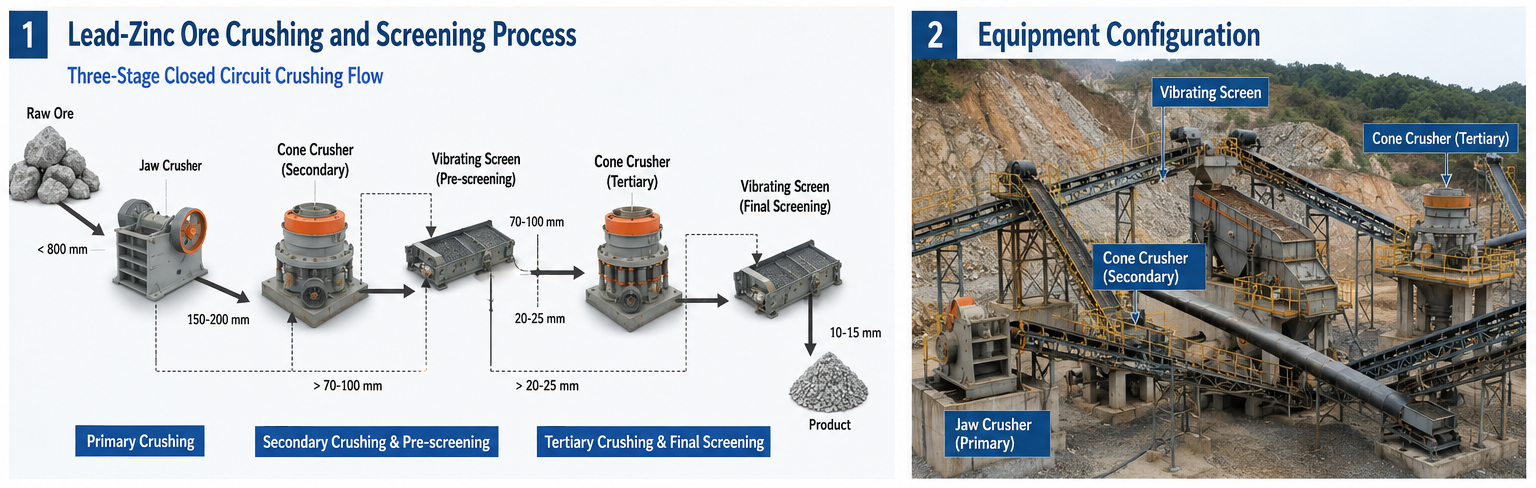
2. Typical Three-Stage Closed-Circuit Crushing & Screening Flow
The three-stage closed-circuit crushing process is the mainstream configuration for medium and large-scale lead-zinc beneficiation plants, offering high stability and strong ore adaptability.
2.1 Primary Crushing Stage: Raw Ore Size Reduction
Recommended Equipment: Jaw Crusher (or large gyratory crusher)
Feed Size: ≤800mm
Discharge Size: 150–200mm
Primary crushing completes the initial size reduction of large ore blocks to meet the feed requirements of secondary crushing equipment.
Key Operational Requirements:
Install iron removal devices to prevent metal debris from entering the crushing production line
Ensure continuous and stable feeding via vibrating feeders
Control impact loads from large ore blocks to extend jaw crusher plate service life
2.2 Secondary Crushing + Pre-Screening
Recommended Equipment: Standard Cone CrusherAuxiliary Equipment: Circular Vibrating Screen (double-deck)
Screening Flow Design:
Top Deck (70–100mm): Oversize returns to secondary crushing
Bottom Deck (20–25mm): Oversize advances to tertiary crushing
Undersize: Directs to fine ore bin or next processing stage
Process Optimization Benefits:
Significantly reduces secondary crushing load, improving overall crushing and screening system throughput
Early classification minimizes unnecessary crushing, enhancing comprehensive system efficiency
2.3 Tertiary Crushing + Check Screening (Closed Circuit)
Recommended Equipment: Short-Head Cone CrusherAuxiliary Equipment: Vibrating Screen Closed-Circuit System
Standard Process Flow:
Tertiary Crushing → Check Screening → Qualified Product (10–15mm) to Fine Ore Bin → Oversize Returns to Tertiary Crusher forming Closed-Circuit Loop
Core Control Indicators:
Screening Efficiency: ≥85%
Circulating Load: Recommended 200%–300%
Real-time monitoring to prevent cone crusher "choke feeding"
3. Two-Stage Closed-Circuit Crushing: Optimal for Small-to-Medium Plants
For small-to-medium lead-zinc beneficiation plants with smaller raw ore size or limited throughput, the two-stage closed-circuit crushing flow offers superior cost-effectiveness.
Circuit Structure:
Primary Crushing: Jaw Crusher (handling ore ≤80mm)
Secondary Crushing: Short-Head Cone Crusher or high-efficiency fine crusher
Screening Control: Vibrating Screen closed-loop system ensures discharge particle size
Configuration Comparison:
| Comparison Factor | Two-Stage Closed-Circuit | Three-Stage Closed-Circuit |
|---|---|---|
| Process Complexity | Simple | More Complex |
| Investment Cost | Lower | Moderate |
| Footprint | Small | Larger |
| Ore Adaptability | General | Strong |
| Suitable Scale | Small-Medium Plants | Medium-Large Plants |
4. Lead-Zinc Ore Crushing & Screening Equipment Selection Guide
Scientific mineral processing equipment selection is fundamental to efficient crushing and screening operations. Recommended configurations by stage:
| Stage | Recommended Equipment | Core Advantages | Main Wear Parts |
|---|---|---|---|
| Primary Crushing | Jaw Crusher | Strong adaptability, high impact resistance | Jaw plates, toggle plates |
| Secondary Crushing | Standard Cone Crusher | Stable capacity, uniform discharge size | Mantle, concave |
| Tertiary Crushing | Short-Head Cone Crusher | High precision particle size control | Mantle, concave |
| Screening | Circular Vibrating Screen | High efficiency, adaptable to wet sticky ore | Polyurethane Screen Panels |
Special Condition Equipment Recommendations
High-Clay Ore: Install ore washing equipment (trommel scrubber or trough washer) to reduce downstream choking risks
Screen Media: Prioritize polyurethane screen panels over traditional metal mesh for superior anti-blinding performance and longer replacement intervals
Mobile Operations: Consider wheel-mounted mobile crushing plants or crawler mobile crushing stations for flexible site relocation
5. Common Faults & Solutions in Crushing & Screening Systems
5.1 Cone Crusher Choke Feeding
Root Cause: Excessive clay content or excessive moisture in feed materialSolutions:
Strictly control feed moisture content
Add pre-screening stages
Strengthen ore washing pretreatment
Optimize bin bottom drainage structure design
5.2 Vibrating Screen Blinding
Root Cause: High fine mud content or improper screen specification selectionSolutions:
Replace with polyurethane screen panels
Add spray washing systems on screen surface
Adjust vibrating screen amplitude and deck angle
Establish regular screen surface cleaning protocols
5.3 Product Size Non-Compliance
Root Cause: Screen media damage or low closed-circuit screening efficiencySolutions:
Strengthen screen inspection and timely replacement
Reasonably control circulating load ratio
Improve check screening efficiency to target values
Optimize return conveyor feed rate
6. Upgrade & Retrofit Strategies for Aging Beneficiation Plants
For long-operating lead-zinc processing plants, systematic technical upgrades can significantly improve overall beneficiation production line performance.
6.1 Process Flow Optimization
Upgrade single-stage open-circuit flows to closed-circuit crushing systems
Add pre-screening and check screening stages
Optimize crushing stage configuration to match actual ore characteristics
6.2 Core Crushing Equipment Upgrades
Replace aging spring cone crushers with high-efficiency hydraulic cone crushers
Upgrade tertiary crushing equipment to improve fine crusher throughput
Replace with energy-saving vibrating screen systems to reduce unit energy consumption and maintenance downtime
6.3 Screening System Refinement
Replace all screens with polyurethane screen panels
Add spray dust suppression systems on screen decks
Improve screening efficiency and reduce circulating load rates
Optimize screening area and vibration parameter matching
6.4 Conveying & Bin System Retrofits
Upgrade belt conveyors to enclosed conveying systems
Add buffer bins at critical nodes
Optimize chute structures for anti-blocking and anti-spillage design
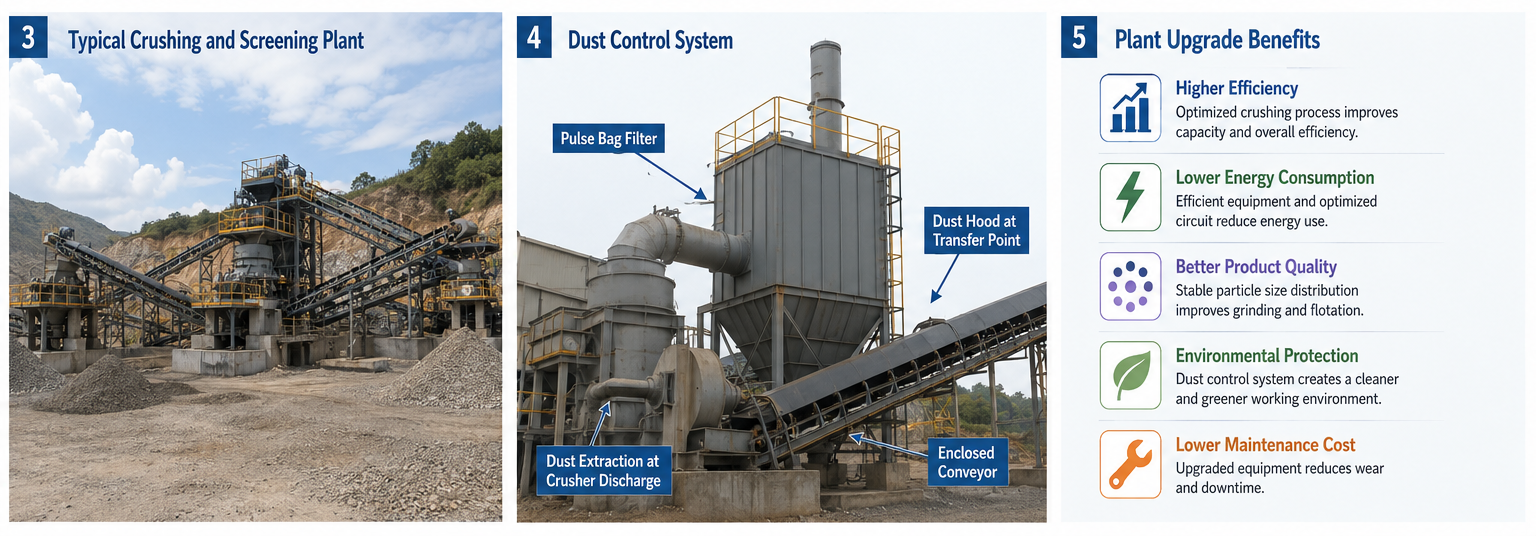
7. Dust Collection System Configuration for Crushing & Screening Plants
Crushing and screening workshops are major dust generation sources in mining operations and require systematic mining dust control equipment solutions.
7.1 Priority Dust Control Zones
Raw ore discharge points
Jaw crusher and cone crusher feed/discharge openings
Vibrating screen screening areas
Belt conveyor transfer points
Fine ore bin tops
7.2 Zone-Specific Dust Control Recommendations
| Zone | Recommended Method | Applicable Equipment |
|---|---|---|
| Primary Crushing Workshop | Pulse-jet baghouse dust collector | Large bag filter systems |
| Screening Workshop | Centralized baghouse system | Modular dust collector units |
| Transfer Points | Enclosed hood + negative pressure extraction | Local dust extraction devices |
| High-Moisture Areas | Spray dust suppression | Atomizing spray systems |
| Bin Tops | Bin vent dust collectors | Small pulse-jet collectors |
7.3 Dust System Design Essentials
Prioritize fully enclosed crushing plant design
Properly match airflow capacity to dust generation points
Avoid relying solely on dry dust collection in high-moisture material conditions
Configure automatic pulse cleaning and differential pressure monitoring
Utilize variable frequency drives on fans to reduce dust system energy consumption
8. Green Mining & Intelligent Development Trends
Future lead-zinc ore crushing and screening systems will evolve toward:
Energy-Efficient Crushing Equipment: New-generation crushers with lower specific energy consumption
Intelligent Control Systems: DCS/PLC automation with real-time operational parameter optimization
Modular Mobile Crushing Plants: Wheel-mounted mobile crushers and crawler mobile crushing stations for flexible deployment
Fully Enclosed Eco-Friendly Workshops: Full compliance with dust and noise emission standards
Digital Mine Management Platforms: Equipment condition monitoring and predictive maintenance